The Professional Guide to Haptic Systems in High-Performance Simulation
A high-performance simulator without a sophisticated haptic system isn't actually a simulator; it's just a high-resolution video game. Most drivers struggle with inconsistent lap times because they can't feel the car's limits, often missing the subtle cues of understeer or rear-end snap until it's too late to react. Unlike basic vibration motors that provide generic buzzing, a professional haptic system transforms raw telemetry into precise physical sensations. We recognize that this sensory gap is the primary barrier between a hobbyist setup and a professional training tool, and this guide will show you how to bridge it using elite motion technology.
As the haptic technology market grows toward an $11.27 billion valuation in 2026, the distinction between consumer toys and professional tools has never been clearer. We'll explore how professional-grade haptic systems bridge the gap between digital data and physical sensation for elite sim racing. You'll also see how Apevie Simulators provides the white-glove installation and turnkey solutions necessary to ensure these complex systems work in perfect harmony, allowing you to focus entirely on your performance and realistic muscle memory training.
Key Takeaways
- Learn why a professional haptic system relies on closed-loop telemetry rather than generic vibration to deliver accurate, physics-based feedback.
- Understand the critical distinction between kinesthetic forces and tactile sensations to better interpret what your car is doing at the limit.
- Discover why high-rigidity aluminum extrusion rigs are non-negotiable for preserving the fidelity of high-end motion components.
- Explore the essential role of specialized software like Simucube True Drive in translating raw simulation data into meaningful physical cues.
- See how expert calibration and white-glove installation eliminate the technical hurdles of setting up elite simulation gear.
Defining the Modern Haptic System: More Than Just Vibration
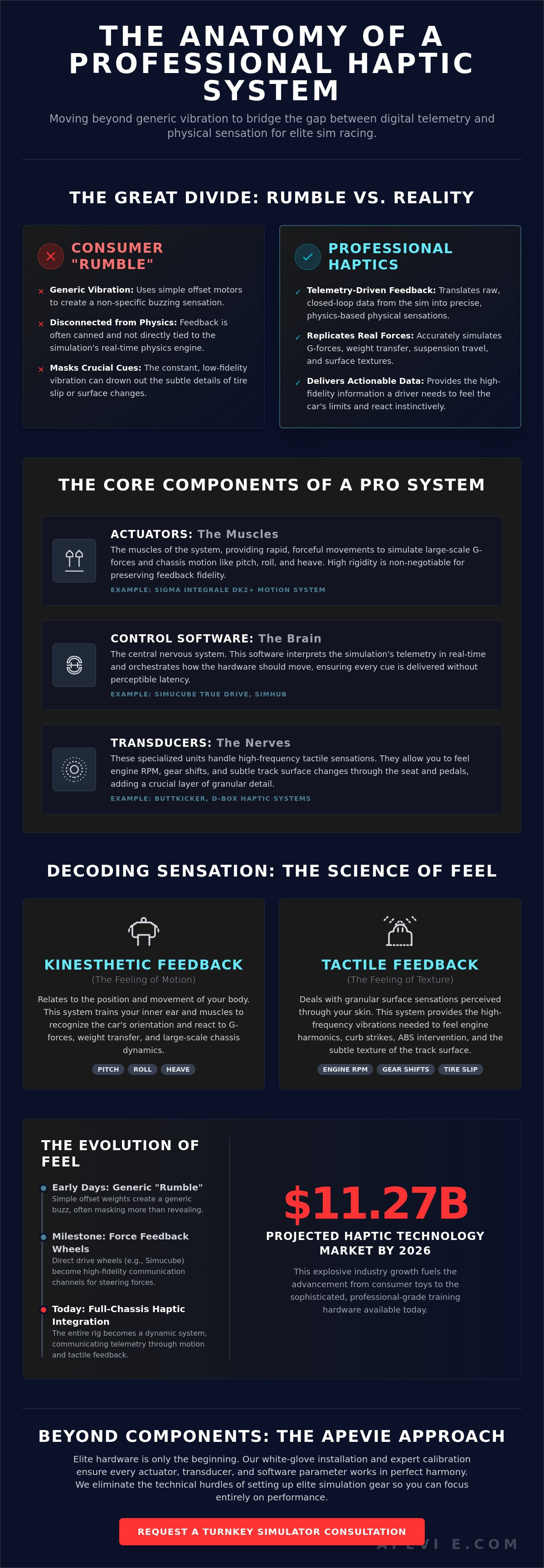
A professional haptic system is a sophisticated bidirectional interface that translates raw digital telemetry into nuanced physical sensations. It acts as the critical bridge between the physics engine of a simulation and the driver's central nervous system. While entry-level gear relies on simple "rumble" motors that provide a generic buzz, a high-fidelity system provides precise control over force, frequency, and amplitude. This level of detail is essential for closing the sensory loop. When you can feel the exact moment a tire loses its grip or the subtle texture of a curb, your brain stops guessing and starts reacting with instinctive precision.
Current 2026 industry benchmarks, influenced by standards like SAE J3280_202306, emphasize the necessity of high-frequency response to simulate realistic surface textures. This isn't just about immersion; it's about data density. Haptic technology in professional simulation ensures that every bit of telemetry, from suspension travel to engine harmonics, reaches the driver without the muddying effect of low-quality vibration. With the global haptic technology market projected to reach $11.27 billion in 2026, the hardware is becoming increasingly capable of replicating the violent yet informative nature of a race car's cockpit.
The Evolution from Force Feedback to Full Haptics
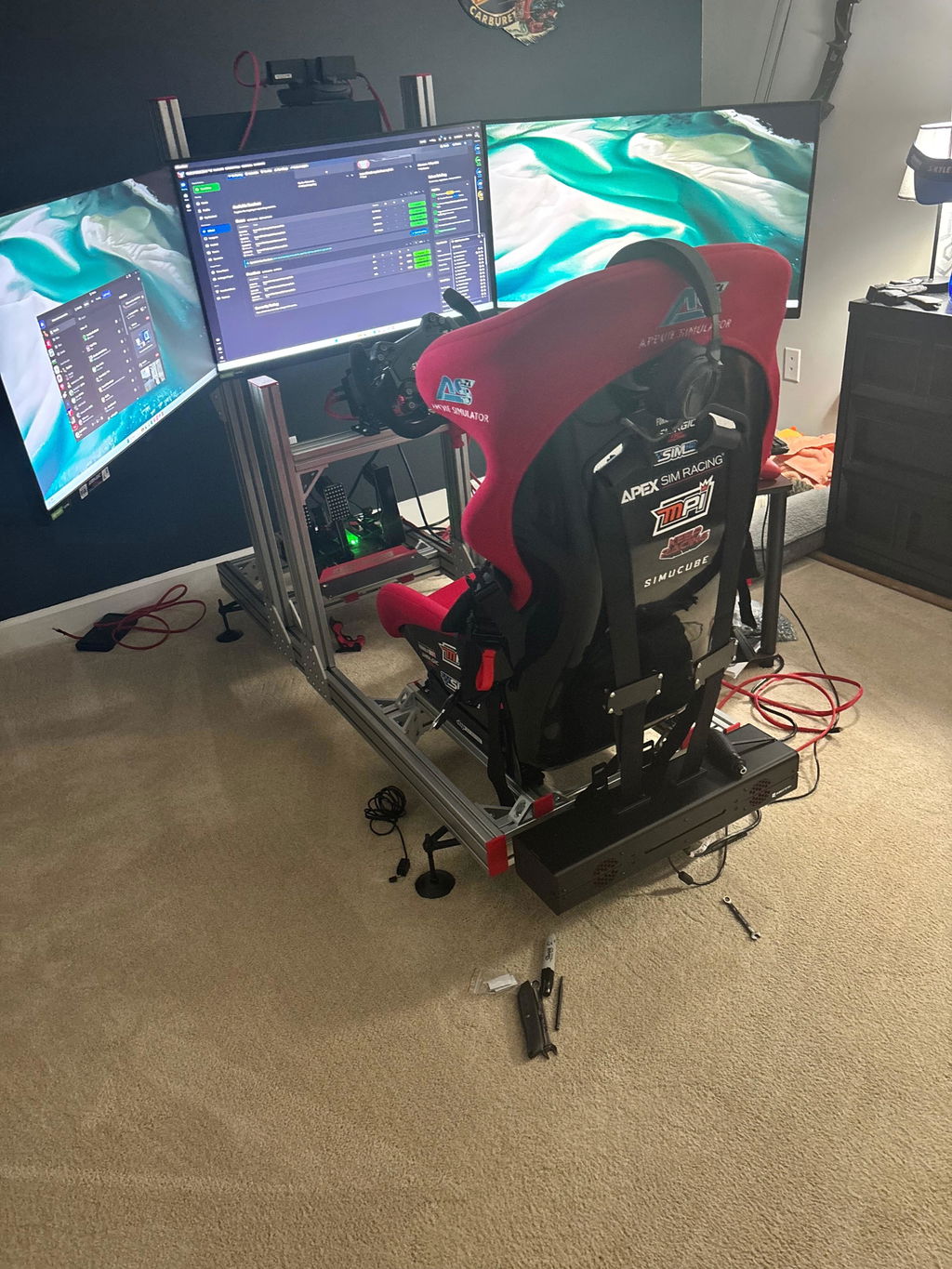
The journey from early arcade "rumble" effects to modern simulation has been transformative. Early systems used simple offset weights to create a generic vibration that often masked more than it revealed. Today, direct drive wheel bases like the Simucube 2 Pro or the latest Simucube 3 serve as the foundational haptic component. These bases don't just provide steering resistance; they act as high-fidelity communication channels. We've moved beyond steering-only feedback toward full-chassis integration. In a high-performance setup like the Apevie AS3, the entire rig becomes an extension of the car's suspension, communicating weight transfer that a wheel alone cannot convey.
Key Components of a Simulation Haptic System
Building a professional-grade setup requires three core elements working in perfect unison to prevent sensory lag or signal clipping:
- Actuators: These are the muscles of the system. High-end units like the Sigma Integrale DK2+ provide the rapid, forceful movements needed to simulate G-forces and large-scale chassis movement.
- Control Software: This is the brain. Software like Simucube True Drive or SimHub interprets the simulation's telemetry and dictates how the hardware should move in real-time.
- Transducers: These specialized units handle high-frequency vibrations. They allow you to feel engine RPM, gear shifts, and subtle track surface changes through the seat and pedals, providing the "tactile" layer of the experience.
When these components are integrated correctly, they eliminate the "dead zones" in your perception, allowing for more consistent lap times and faster development of muscle memory.
The Science of Feel: Kinesthetic vs. Tactile Feedback
To master a car at its absolute limit, you need more than just visual and auditory data. You need a haptic system that speaks directly to your body's mechanoreceptors. Scientific research into kinesthetic vs. tactile feedback reveals that our brains process these physical inputs through distinct neurological pathways. Kinesthetic feedback relates to the position and movement of our limbs and torso, while tactile feedback deals with the granular surface sensations perceived through our skin. In a high-performance simulator, these two forces must work in a delicate balance. If they aren't synchronized, the result is "sensory mud," a state where the driver is overwhelmed by noise and cannot distinguish a curb strike from a loss of rear-end grip.
Kinesthesia: Training the Body for High-G Loads
Modern motion systems, such as the Sigma Integrale DK2+, are engineered to provide these essential vestibular cues. When you enter a high-speed corner, the system simulates pitch, roll, and heave to communicate weight transfer. This isn't just about the "feeling" of motion; it's about training your inner ear to recognize the car's orientation in space. Professional-grade systems prioritize latency-free motion because even a few milliseconds of delay can lead to motion sickness and broken immersion. By accurately simulating the heave of a car over a crest, you develop the muscle memory required to catch a slide before it even happens.
Tactile Precision: Feeling the Curb and the Limit
While kinesthesia handles the large-scale movements, tactile feedback provides the high-frequency detail. This is where you feel the slip angle of the tires before the car actually begins to spin. High-end hardware like the Heusinkveld Sim Pedals Ultimate+ utilizes tactile feedback to communicate ABS activation and wheel lock directly through your foot. The frequency response is vital here. While a standard consumer motor might vibrate at a muddy 50Hz, a professional transducer can range from 20Hz for deep engine thumps to over 200Hz for the sharp "clack" of a gear change or the fine texture of a rumble strip.
Balancing these two types of feedback is a specialized art form. If the vibrations are too intense, they mask the kinesthetic cues of weight transfer, making it impossible to feel the car's balance. This is why a custom high-performance racing simulator from Apevie Simulators is calibrated by experts who understand the biological limits of human perception. We ensure that every component, from the actuators to the pedals, works in a cohesive ecosystem that sharpens your senses rather than overwhelming them with useless noise.
Haptic Systems in Professional Simulation vs. Consumer Hardware
A common misconception in the sim racing community is that any vibration qualifies as haptic feedback. This "Rumble Fallacy" often leads enthusiasts to invest in consumer-grade hardware that actually masks critical driving data with generic buzzing. A professional haptic system operates on an entirely different principle: closed-loop communication. While consumer gear sends a simple one-way signal to a motor, professional systems use high-speed encoders to ensure the hardware's physical output perfectly matches the physics engine's requirements. This precision is what allows a driver to distinguish between a tire scrubbing across the asphalt and a mechanical failure, a distinction that's often lost in cheaper setups.
Durability also separates professional tools from gaming peripherals. Industrial-grade actuators used in a Sigma Integrale DK2+ motion system are designed for high duty cycles. They're capable of maintaining peak performance during 24-hour endurance simulations without thermal throttling. In contrast, consumer hardware often suffers from signal degradation as components heat up. This leads to inconsistent feedback when it matters most, such as the final stint of a long-distance race. The technical experts at Apevie Simulators prioritize components that avoid this performance decay, ensuring the feedback you feel at minute one is identical to what you feel at hour twenty-four.
Direct Drive vs. Belt/Gear Systems
The fidelity loss in belt or gear-driven systems is measurable and significant. These mechanical interfaces act as filters, absorbing the high-frequency details that communicate road texture. The Simucube 3 stands as the gold standard for haptic steering response in 2026, offering a direct, unfiltered connection to the virtual front wheels. This eliminates "clipping," a phenomenon where the hardware reaches its torque limit and stops communicating changes in grip. Without this headroom, the driver is effectively left blind during high-load cornering, unable to feel the subtle drop in resistance that signals understeer.
Active vs. Passive Haptic Components
Passive components, like static aluminum extrusion rigs, rely solely on the driver's eyes and ears. While these are stable, they lack the "active" element that physically moves the driver to induce feel. The most effective professional setups use a hybrid approach. This combines the large-scale kinesthetic motion of a platform like those provided by ProSimu or Sigma Integrale with high-frequency tactile transducers. By layering these effects, you create a comprehensive sensory environment where the "heave" of the chassis and the "hum" of the engine exist as distinct, readable data points rather than a single, muddled vibration.
Implementing Haptics: Integration, Software, and Chassis Rigidity
Chassis flex is often called the "haptic killer" because it acts as an unintended dampener. If your cockpit isn't perfectly rigid, the energy generated by your actuators will be lost as the frame bends and groans. To prevent this, aluminum profile rigs are non-negotiable for a professional haptic system. These modular frames provide the rock-solid foundation needed to transmit high-frequency telemetry directly to the driver's body rather than letting it dissipate into a flimsy steel structure. Without this mechanical integrity, even the most expensive motion platform will feel muddy and imprecise.
The software layer serves as the interpreter between the simulation's physics engine and your hardware. It's where you distinguish between "noise" and "signal." For example, you don't want engine RPM vibrations to be so loud that they mask the subtle tire scrub data coming through the chassis. Tuning your telemetry ensures that each sensation has its own space, allowing you to focus on the data that actually improves your lap times. In 2026, the complexity of these software ecosystems requires a methodical approach to calibration, ensuring that what you feel matches your field of view and audio cues perfectly.
The Role of Aluminum Extrusion
A rigid foundation is required to prevent energy loss from actuators. When mounting transducers, we use specific strategies to maximize bone-conduction feel, ensuring vibrations travel through the seat and pedals rather than the floor. This direct contact is what creates the sensation of being "in" the car rather than just sitting on top of a vibrating chair. You can refer to our Ultimate Sim Rig Guide for more detail on choosing a chassis that can handle these forces.
Software Configuration for Precision
Comparing ecosystems like D-BOX G5 and Sigma Integrale reveals different philosophies in tactile delivery. D-BOX often focuses on a streamlined, proprietary experience, while Sigma Integrale allows for deep customization of telemetry channels. We recommend setting up "Zones of Feel" based on the car type you're driving. A GT3 car requires more suspension travel detail to handle curbs, while a Formula car needs higher-frequency response to communicate downforce and aerodynamic load. Keeping your firmware updated is critical in 2026 to ensure your haptic system remains compatible with the latest tire model updates in iRacing and ACC.
For those who want to avoid the steep learning curve of software calibration, Apevie offers custom high-performance racing simulator solutions that are pre-configured for peak fidelity. Our team handles the complex integration of hardware and software, providing a turnkey experience that's ready for elite competition the moment it's installed.
The Apevie Approach to High-Fidelity Haptic Integration
At Apevie, we believe that a truly professional haptic system is greater than the sum of its individual components. Our selection process is rooted in a refusal to compromise on data fidelity. We exclusively stock and install hardware from Simucube, Sigma Integrale, and Heusinkveld because these brands share a common goal: the total elimination of signal latency. When we integrate a Simucube 3 wheel base with Heusinkveld Sim Pedals Ultimate+, we aren't just bolting parts to a frame. We're creating a seamless communication loop where every micro-adjustment of the throttle and every ounce of steering torque is reflected in the chassis motion with absolute transparency.
The complexity of modern simulation often becomes a barrier to performance rather than an aid. Calibrating a multi-actuator setup to feel "natural" requires dozens of hours of fine-tuning across multiple software layers, a task that can overwhelm even the most dedicated racer. Our White-Glove Installation service removes this burden entirely. We handle the technical heavy lifting, from electromagnetic interference (EMI) management to the precise telemetry filtering discussed in previous sections. This ensures that when your custom high-performance racing simulator arrives, it's already optimized for your specific driving style and preferred titles.
Curated Hardware for Elite Performance
We position the Sigma Integrale DK2+ as the core of our motion builds because of its unmatched response time and industrial durability. To complete the haptic loop, we often pair these systems with elite steering interfaces from Gomez Sim Industries (GSI) or Cube Controls. These wheels provide the tactile "handshake" needed to feel the front tires' scrub through your fingertips. You can explore our guide on the best F1 steering wheels to see how these components integrate into a wider haptic system for formula-style racing.
The Future of Simulation Haptics
Looking toward the remainder of 2026 and beyond, the industry is shifting toward even higher frequency responses and smarter, AI-driven telemetry. As the global haptic market expands toward its projected $16.19 billion valuation by 2030, we're seeing a move from "seat-only" feedback to "full-body" haptic environments and advanced cutaneous interfaces. These advancements will allow professional motorsport teams to train for endurance events with even greater biological accuracy. If you're ready to move beyond "gaming" and invest in a professional training tool, contact Apevie Simulator today for a turnkey build or an expert consultation to refine your current setup.
Mastering the Sensory Loop for Elite Performance
Transitioning from visual-only driving to a fully integrated sensory experience marks the boundary between enthusiast gaming and professional motorsport training. A high-fidelity haptic system ensures that every ounce of tire scrub and weight transfer is communicated with surgical precision. We've explored how the synergy between rigid aluminum frames and closed-loop telemetry translates digital physics into biological reality, allowing you to build the muscle memory necessary for consistent, winning lap times. When your equipment stops being a toy and starts being a data interface, your potential on the track becomes limitless.
As an authorized Simucube and Sigma Integrale dealer, Apevie provides the expertise required to navigate the complexities of high-end motion. We offer white-glove installation nationwide and custom turnkey professional builds that eliminate the technical frustrations of calibration. Your journey toward ultimate immersion starts with hardware that matches your ambition. We're ready to help you Build Your Professional Haptic Rig with Apevie Simulators and transform your simulator into a world-class training tool. The limit of your car is finally within reach; it's time to feel it for yourself.
Frequently Asked Questions
What is a haptic system in sim racing?
A haptic system is a sophisticated communication channel that translates digital telemetry from the simulation physics engine into physical sensations. It uses a combination of actuators and transducers to provide drivers with real-time data regarding grip levels, track textures, and vehicle weight transfer. This sensory feedback allows your body to react instinctively to car behavior often before your eyes can process the visual changes on the screen.
Is a motion system the same as a haptic system?
No, a motion system is actually a specific component within a broader haptic ecosystem. While motion platforms like the Sigma Integrale DK2+ handle kinesthetic feedback such as G-forces and chassis pitch, a complete system also includes tactile transducers for high-frequency vibrations. Professional setups combine both to ensure you feel everything from the massive heave of a jump to the subtle hum of the engine.
Can haptics actually make me faster on track?
Yes, high-fidelity haptics directly contribute to faster lap times by significantly reducing your reaction time. By feeling the exact moment of tire scrub or ABS intervention through your pedals and seat, you can adjust your inputs with much greater precision. This prevents overdriving and leads to more consistent performance, especially during long endurance stints where visual fatigue typically begins to set in.
How much does a professional haptic system cost?
The investment for a professional setup varies significantly based on the number of actuators and the level of integration required. Instead of focusing on a single price point, it's better to consider the long-term value of industrial-grade components like the Sigma Integrale DK2+ system. These units are built for extreme durability and maintain their fidelity over years of heavy use, unlike entry-level consumer gear.
Do I need a special PC to run a haptic motion system?
You need a high-performance PC with a modern processor and a powerful GPU to handle the high telemetry refresh rates required for accuracy. Systems in 2026 often utilize hardware like the RTX 4080 or the next-generation RTX 5090 to ensure the physics engine and haptic software run without latency. Any lag in the data stream can lead to a disconnect between the visuals and the physical sensations.
Is D-BOX better than Sigma Integrale for haptics?
Both systems offer elite performance but cater to slightly different user requirements. D-BOX is widely known for its refined, proprietary integration and streamlined ease of use. Sigma Integrale, particularly the DK2+ system, provides an industrial-grade and highly customizable experience that many professional sim racers prefer for its raw power and granular software control. The ideal choice depends on your specific performance goals.
What software is best for controlling sim racing haptics?
Professional simulation haptics typically rely on specialized software like Simucube True Drive or SimHub to interpret complex telemetry data. These platforms allow you to fine-tune the signal-to-noise ratio, ensuring that critical data like tire slip isn't masked by engine vibrations. Most high-end hardware manufacturers also provide their own dedicated drivers to maximize the specific mechanical capabilities of their actuators.
Can I add haptics to my existing aluminum profile rig?
Yes, an aluminum profile rig is the perfect foundation for adding a haptic system because of its modularity and extreme rigidity. You can easily bolt on actuators or add tactile transducers to the seat and pedal tray. This rigid structure ensures that the energy from the haptic components is transmitted directly to the driver's body rather than being lost to chassis flex or vibration dampening.