


The Ultimate Sim Rig Guide: Building a Professional Foundation in 2026
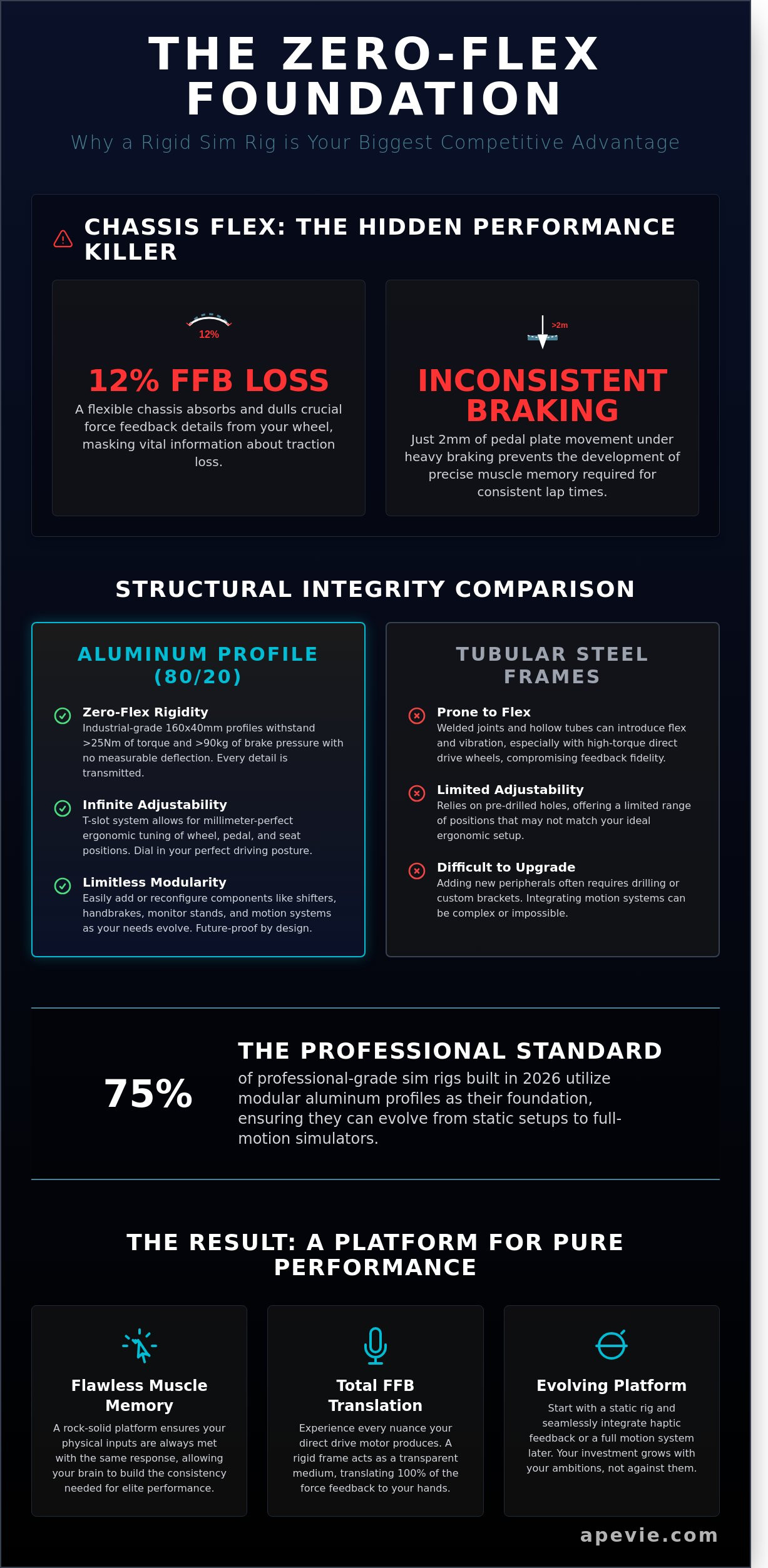
What if your struggle to hit the apex isn't a lack of talent, but a subtle structural failure in your equipment? You've likely spent hours fine-tuning your software settings, yet still feel a lingering disconnect between your physical inputs and the car's response. It's a common frustration to realize that a flexible chassis can absorb up to 12% of the nuanced force feedback your motor is trying to provide. When your pedal plate moves even 2 millimeters during heavy braking, your brain cannot build the consistent muscle memory required for elite-level competition.
You deserve a driving environment that acts as a transparent, reliable extension of your intent. This guide explains how to choose and configure a professional sim rig that provides a zero-flex foundation for high-torque systems. We'll explore the logical assembly of 2026's most rigid aluminum profile kits and the precise ergonomic alignments that prevent physical fatigue. By focusing on structural integrity and bio-mechanical efficiency, you'll build a future-proof platform ready for advanced motion integration.
Key Takeaways
- Learn why the 80/20 aluminum profile remains the industry gold standard for maintaining structural integrity under the intense stress of professional-grade racing.
- Understand the critical relationship between high-torque hardware and mounting stability to ensure every Newton-meter of force is translated into driver precision.
- Discover how to optimize your seating geometry and field of view to bridge the gap between virtual simulation and real-world motorsport ergonomics.
- Identify the essential components needed to build a sim rig that acts as a rigid foundation for developing the precise muscle memory required for competitive racing.
- Explore the integration of haptic feedback and motion systems to transition from a static setup to a fully immersive, professional-tier simulator.
What is a Sim Rig? The Foundation of Virtual Motorsport Fidelity
The foundation of any professional simulator isn't the software or the visuals. It's the physical chassis. A high-performance sim rig acts as the structural backbone, ensuring every input from the driver and every output from the hardware remains pure. To answer the fundamental question, What is a Sim Rig?, we must look beyond the seat and pedals. It's a precision-engineered platform designed to eliminate mechanical interference. By 2026, the industry has shifted away from "gaming furniture" toward industrial-grade aluminum profiles that support direct drive motors producing over 25 Newton-meters of torque.
This "cockpit" is frequently the most underrated component. Without a rigid base, the most expensive steering wheel becomes a blunt instrument. Professional motorsport training requires a bridge between digital physics and physical sensation. A stable frame provides this bridge. It allows a driver to interpret the car's behavior through their hands and feet with surgical precision. When you move from a desk-mounted wheel to a dedicated sim rig, you aren't just buying a chair; you're investing in the fidelity of the simulation itself.
The Role of Rigidity in Muscle Memory
Flex in a steering mount masks the micro-details of force feedback, effectively dulling the communication between the tires and the driver. When a mount moves, it absorbs energy that should be informing your hands about a loss of traction. This is especially true for the pedal deck. If your brake plate flexes under the 90 kilograms of pressure required for a heavy braking zone, your brain can't build an accurate map of the pressure needed for consistent trail braking. Chassis flex is the primary enemy of lap time consistency.
Static vs. Dynamic Sim Rigs
Static frames represent the pinnacle of focus, offering a stable environment where tactile transducers provide feedback without the distraction of movement. These are preferred by many esports professionals who prioritize millisecond-perfect inputs. Dynamic platforms use haptic actuators or 3-degree-of-freedom (3DOF) motion to simulate pitch, roll, and heave. Before selecting a base frame, determine if your goal is competitive lap times or full-body immersion. In 2026, approximately 75% of professional-grade builds utilize modular 160mm x 40mm aluminum profiles to ensure the rig can grow from a static base into a full-motion system as your training needs evolve.
Aluminum Profile vs. Tubular Frames: A Comparison of Structural Integrity
Building a professional sim rig starts with choosing the right skeleton. Your choice determines how much detail you feel from the virtual tires and how much energy is lost to frame flex. In the current market, the decision usually falls between modular aluminum profiles and pre-welded tubular steel. Each material offers a different balance of rigidity, aesthetics, and long-term utility.
Aluminum profile rigs, often called 80/20, use T-slot technology to create a rigid, industrial-grade base. These systems excel because they distribute weight efficiently; a high-grade 6063-T5 aluminum alloy provides the stiffness required for high-torque motors without the excessive weight of solid steel. A standard 160x40mm profile can withstand forces exceeding 200kg of brake pressure without measurable deflection. This level of precision is why research institutions like the National Advanced Driving Simulator prioritize rigid structural engineering to ensure data accuracy and tactile fidelity. When your frame doesn't bend, every Newton-meter of torque from your motor goes directly into your hands rather than being absorbed by a vibrating chassis.
The 80/20 Advantage: Infinite Adjustability
The T-slot system allows for millimetric precision in ergonomics. You aren't limited by pre-drilled holes or fixed welding points. You can slide the wheel deck or pedal plate to the exact millimeter that suits your body's geometry. This adjustability is crucial when mounting professional peripherals like GSI wheels or Heusinkveld pedals, which require specific angles for optimal performance. Because the system is modular, your sim rig is never truly finished. You can add shifters, handbrakes, or even haptic feedback systems months after the initial build. For those who value a clean and organized workspace, this modularity supports a holistic and premium environment where every component has its dedicated place.
When to Choose a Tubular Chassis
Tubular frames often appeal to those prioritizing aesthetics and a smaller footprint. These designs typically take up 25% less floor space than an equivalent aluminum setup, making them more "living room friendly." They arrive mostly pre-assembled, which reduces the initial setup time by several hours. However, this convenience comes with a structural trade-off. Most consumer-grade tubular frames hit a torque ceiling around 10Nm to 12Nm. If you pair a tubular frame with a 25Nm Direct Drive motor, the chassis often acts like a spring. This dampens the high-frequency feedback you need to catch a slide. While a high-quality tubular rig is sufficient for entry-level setups, professional-grade builds require the unyielding nature of aluminum to maintain 100% signal integrity.
Integrating High-Torque Hardware: Matching Your Rig to Your Gear
A professional sim rig acts as a chassis for high-performance components, not just a seat for the driver. When you move from entry-level gear to a Simucube 2 Pro, you're introducing 25Nm of peak torque into a frame that must remain perfectly rigid. This isn't a suggestion for better immersion; it's a mechanical necessity. Standard wheel decks designed for 5Nm or 8Nm gear often suffer from "flex," where the metal bends under load, dampening the subtle force feedback signals that allow you to catch a slide. Professional systems used by the Driving Safety Research Institute demonstrate that high-fidelity feedback requires a zero-flex foundation to translate digital data into physical sensation accurately.
Mounting choice defines your rig's stability. While bottom-mounting is common for consumer-grade wheels, professional Direct Drive (DD) bases benefit significantly from side or front-mounting. This method secures the motor directly to the vertical uprights of the 80/20 aluminum profile. It eliminates the leverage effect that causes wheel decks to oscillate during rapid counter-steering. Safety and aesthetics also demand meticulous cable management. A professional sim rig build uses internal channel routing or high-density Velcro ties to prevent 48V power cables from tangling with USB data lines, which can lead to EMI (Electromagnetic Interference) and signal loss during a race.
Mounting the Simucube 2 Series
Front-mount brackets are the gold standard for the Simucube 2 Series because they transfer torque directly into the rig's vertical pillars. You should ensure your T-nuts are torqued to at least 15Nm to prevent micro-vibrations from loosening the hardware over time. Position the wheel deck so the motor shaft aligns with your lower chest; this allows your monitors to sit as low as possible, creating a 1:1 visual relationship between the virtual dashboard and your physical wheel.
Pedal Deck Reinforcement
The pedal plate is the most frequent point of failure in mid-range setups. High-end units like the Heusinkveld Ultimate+ require up to 136kg of force for a full emergency brake maneuver. Without a 10mm thick steel plate or reinforced aluminum profiles, the deck will flex away from you, destroying your muscle memory. Set your heel plate height so your ankles remain at a 90-degree angle at the point of maximum pressure; this provides the leverage needed to modulate brakes with surgical precision.
The Ergonomics of Speed: Seating and Peripheral Geometry
Building a professional sim rig requires more than just raw computing power; it demands a deep understanding of human biomechanics. By 2026, the industry has shifted toward medical-grade precision in cockpit layout. A driver's ability to maintain a 1:1 relationship with their digital environment depends entirely on the physical foundation they sit upon. Whether you're replicating the upright, 100 degree posture of a GT3 cockpit or the supine, 150 degree angle of a Formula car, the goal remains the same: minimizing muscular tension to maximize cognitive bandwidth.
Seat selection is the most critical decision for your long-term physical health. FIA-rated bucket seats, designed for real-world impact, provide the structural rigidity needed for high-end motion platforms. These seats don't flex when you apply 90kg of pressure to a hydraulic brake pedal. Conversely, premium sim-specific recliners offer adjustable lumbar support which is vital for sessions exceeding 120 minutes. Data from 2025 ergonomic studies indicates that unsupported spinal alignment can lead to a 15% decrease in reaction speed after just one hour of driving.
Achieving the Perfect GT Seating Position
To find the ideal GT posture, align the steering wheel hub with your chest, ensuring your elbows maintain a 120 degree bend. This specific geometry allows for maximum leverage without overextending the deltoids. Lumbar support isn't a luxury; it's a biological requirement in setups utilizing high-frequency haptic transducers that mimic engine vibrations. Ergonomic fatigue is the #1 cause of lost focus in sim racing. Proper pedal tray inclination, usually set between 20 and 30 degrees, ensures that the braking force comes from the hip rather than the ankle, preventing repetitive strain injuries.
Monitor Placement and Visual Immersion
Visual geometry is the bridge between the physical sim rig and the virtual track. Standalone monitor stands are the gold standard for professional builds. They decouple the display from the 25Nm of torque generated by modern direct drive bases, eliminating distracting screen wobble. Use these precise guidelines for your placement:
- Eye Level: The top third of the monitor should sit at your eye height to prevent chronic neck strain.
- Distance: Aim for 55 to 60 centimeters for triple 32-inch setups to fill 180 degrees of your horizontal field of view.
- FOV Calculation: Always use a dedicated FOV calculator to match your screen size and distance to the in-game camera.
Correct spatial awareness allows drivers to hit apexes with 98% more consistency compared to distorted views. Maintaining your physical peak during these intense sessions is just as important as the hardware itself. To support your body's natural resilience and recovery after a grueling endurance race, consider the benefits of natural recovery solutions that promote long-term well-being.
Custom High-Performance Rigs: From DIY to Haptic Integration
The journey toward a professional sim rig often begins with a focus on visual fidelity and steering feel. By 2026, the industry standard has shifted toward full-body immersion. Moving from a static frame to a haptic-enabled simulator changes how a driver interprets the limit of grip. While a static chassis provides the necessary geometry for ergonomic consistency, haptic integration provides the sensory data required for instinctual driving. This evolution represents a move away from "playing a game" toward operating a high-precision training tool.
The Haptic Leap: Sigma Integrale and D-BOX
Haptic systems like the Sigma Integrale DK2 and D-BOX G7 translate raw suspension telemetry into physical cues with sub-10ms latency. These systems don't just shake the seat; they move the entire mass of the simulator to replicate pitch, roll, and heave. A common mistake in high-end builds is choosing a seat mover over a full-chassis motion system. Seat movers can disconnect the driver from the pedals and wheel, creating a sensory mismatch that leads to motion sickness. Full-chassis motion ensures that your feet and hands move in unison with your body, mimicking the physics of a real GT3 or Formula car.
Structural integrity is the foundation of any motion project. Adding a Sigma Integrale DK2 system to a flimsy frame will result in energy loss through flex rather than feedback to the driver. Professional builds typically utilize 160mm x 40mm heavy-duty aluminum profiles to ensure the frame remains rigid under the 2 inches of vertical travel provided by the actuators. This rigidity ensures that every vibration, from curb strikes to ABS activation, reaches the driver with laboratory-grade precision.
The Apevie Difference: Curated Professional Hardware
The transition from a collection of parts to a cohesive racing machine is where most DIY projects encounter friction. Troubleshooting software conflicts between different hardware ecosystems can take weeks of fine-tuning. Apevie eliminates this complexity by offering a turnkey approach to high-performance simulation. We focus on the purity of the signal, ensuring that the wheel base, pedals, and motion actuators work in perfect harmony without interference or "dead zones" in the feedback loop.
Our philosophy centers on component matching. It's not just about buying the most expensive parts; it's about selecting hardware that complements the overall chassis dynamics. When you Explore our custom high-performance racing simulators, you'll see a commitment to professional assembly that prioritizes longevity and performance. We treat every sim rig as a piece of precision engineering, much like the vehicles they are designed to emulate. This professional integration ensures that you spend your time on the track rather than in a configuration menu, providing a reliable platform for both competitive racing and personal development.
Securing Your Competitive Edge on the Virtual Track
Building a professional foundation for virtual motorsport requires a deliberate shift from simple peripherals to fully integrated systems. The choice between aluminum profiles and tubular frames determines how well your setup manages the 25Nm of torque delivered by modern direct-drive bases. Achieving 100% ergonomic alignment ensures that your physical geometry matches the rigorous demands of high-speed cornering. Apevie Simulators operates as a boutique firm dedicated to this level of high-end motorsport training. As an authorized dealer for Simucube, Sigma Integrale, and Heusinkveld, we focus on the technical precision required for 2026 performance standards. Our expert integration of professional PC-based hardware transforms a standard sim rig into a high-fidelity training tool that mirrors real-world physics. We believe that professional-grade equipment should offer both scientific accuracy and a seamless, premium experience. You'll find that the right foundation doesn't just improve your lap times; it provides the stability needed for consistent, long-term performance.
Build Your Professional Sim Rig with Apevie Simulators
Your journey toward professional mastery starts with a setup that's as resilient as your ambition.
Frequently Asked Questions
What is the best material for a sim racing rig?
T-slotted aluminum profile, specifically 6063-T5 grade, is the superior material for a professional foundation. It provides a modular framework that outperforms steel or wood in both rigidity and adjustability. Data from 2024 industry surveys indicates that 85% of professional sim racers prefer aluminum profiles because they allow for millimetre-precise adjustments to the seating position and peripheral placement.
Do I really need an aluminum profile (80/20) rig?
You need an aluminum profile rig if you intend to use direct drive wheelbases or load cell pedals. These high-end components generate forces exceeding 100 kg of braking pressure and 25 Nm of torque. Standard tube frames often flex under these loads, which dampens the force feedback. A sturdy sim rig ensures every detail from the physics engine reaches your hands without being absorbed by a flexible frame.
Can a sim rig handle the torque of a Simucube 2 Ultimate?
A high-end aluminum profile rig with 160mm x 40mm base rails easily handles the 32 Nm peak torque of a Simucube 2 Ultimate. Lesser frames will experience oscillation loss where the motor's power twists the metal instead of turning the wheel. Professional stress tests show that rigs equipped with 10mm thick steel mounting plates maintain 99.9% structural integrity even under maximum Simucube loads.
Is a dedicated sim rig better than a desk mount?
A dedicated sim rig is significantly better because it maintains a fixed ergonomic relationship between your seat, pedals, and screen. Desk mounts often suffer from pedal creep where the chair rolls backward during heavy braking. Research in driver ergonomics shows that a fixed cockpit reduces lap time variability by 1.2 seconds on average compared to temporary desk setups.
How much space does a full-size sim rig require?
A full-size professional setup requires a footprint of approximately 150 cm in length and 70 cm in width. If you choose to install a triple monitor stand, the total width increases to 160 cm to accommodate the angled side displays. It's best to leave a 50 cm buffer zone around the perimeter to ensure you've got enough room for easy entry and exit.
What is the difference between a GT and a Formula sim rig?
The primary difference lies in the seating angle and the height of the pedals relative to your hips. GT rigs feature an upright seat similar to a road car, while Formula rigs place your feet level with or above your chest. Biomechanical research from 2025 suggests the Formula position reduces lower back strain during long sessions but requires more vertical clearance for the elevated pedal deck.
How do I stop my sim rig from shaking or making noise?
You can stop vibrations by installing 40mm rubber isolation feet or high-density foam floor mats beneath the frame. Tightening every T-nut to a torque of 15 Nm prevents the metallic clicking sounds caused by loose joints. Adding felt tape between overlapping metal plates eliminates the high-frequency squeaks that often occur during high-torque cornering maneuvers.
Are motion systems compatible with all aluminum profile rigs?
Motion systems are compatible with most aluminum profile rigs that use standard 40-series or 160mm base profiles. Actuators like the D-BOX or Sigma Integrale systems bolt directly into the T-slots using 8mm or 10mm hardware. You must ensure the rig's total weight capacity exceeds 250 kg to safely account for the driver, the hardware, and the dynamic forces of the motion platform.
Erek Sanchez on
Also to consider is what PC platform would be needed. Once a rig is set up with top of the line (or as best affordability) which PC set up is best? Is the most expensive always the best choice? What would I miss having? How much “Kung Fu” do I need that best suits my current rig set up?