


The Best F1 Steering Wheels for Professional Sim Racing in 2026
What if the 0.3 seconds standing between you and the top of the podium isn't a lack of skill, but a result of microscopic flex in your equipment? Professional drivers know that a high-quality f1 steering wheel serves as the vital bridge between human intuition and digital physics. You've likely felt the frustration of a plastic rim yielding under the 25 Nm of torque delivered by a modern direct drive base, or the missed opportunity when a mushy shifter fails to engage ERS at the critical moment.
In this article, you'll discover the meticulous engineering and industrial precision behind elite Formula-style wheels to find the perfect match for your high-performance sim rig. We'll analyze how rigid carbon-fibre construction and tactile, industrial-grade rotaries provide the stability required for 2026 competition standards. We'll also preview the latest integrated telemetry displays that offer seamless data visualization to ensure your focus remains entirely on the apex.
Key Takeaways
- Understand why the distinct "butterfly" shape of a professional f1 steering wheel is essential for accurately simulating high-downforce vehicles and maintaining precision on the track.
- Learn how to evaluate critical technical specifications, such as input density for real-time adjustments and the ergonomic benefits of premium materials like silicone and Alcantara.
- Compare the industry’s elite manufacturers, including the rugged durability of Gomez Sim Industries and the sophisticated Italian engineering of Cube Controls.
- Discover the essential mounting standards and quick-release systems required to seamlessly integrate professional hardware with high-end direct drive bases.
- Explore the professional criteria used to select hardware capable of withstanding the rigorous demands of 24-hour endurance racing.
What Defines a Professional F1 Steering Wheel in 2026?
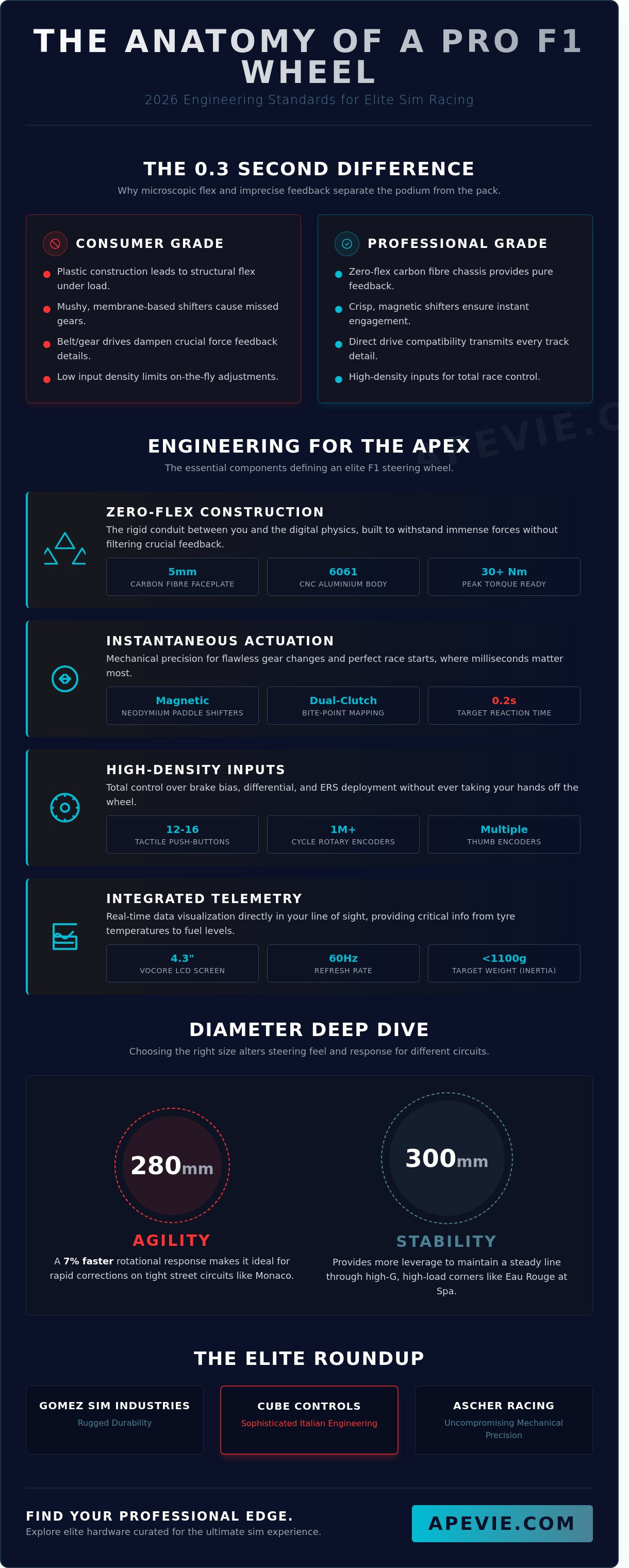
Professional sim racing has moved far beyond the era of plastic peripherals. In 2026, a high-end f1 steering wheel is a precision instrument designed to translate massive amounts of data into physical sensation. The distinction between consumer-grade arcade wheels and professional hardware lies in the fidelity of the communication. While entry-level wheels use internal belts or gears that dampen vibrations, a professional wheel acts as a rigid conduit for the direct-drive motor. The iconic "butterfly" shape isn't just for aesthetics; it's a functional necessity. This compact design allows drivers to apply rapid, high-torque corrections in high-downforce scenarios without the physical interference of a full circular rim.
Material science dictates the performance of these devices. Manufacturers now standardise 5mm carbon fibre faceplates paired with CNC-machined 6061 aluminium housings. This construction isn't merely about durability. It's about eliminating flex. When a Simucube 2 Pro base outputs 25Nm of peak torque, any structural weakness in the wheel acts as a filter, muddying the force feedback. A rigid chassis ensures that the driver feels the exact moment a front tyre loses grip or the specific vibration of a serrated kerb at the Apex of Turn 1 at Interlagos.
- Rigidity: Zero-flex construction using aerospace-grade materials.
- Ergonomics: Hand-moulded silicone or Alcantara grips designed for 2-hour endurance stints.
- Connectivity: High-bandwidth telemetry via USB-C or low-latency wireless protocols.
Tactile Feedback and Mechanical Precision
Mechanical springs have largely disappeared from the professional circuit. Modern f1 steering wheel designs utilise neodymium magnets in their paddle shifters to provide a crisp, binary engagement. This ensures that gear changes are instantaneous, with no risk of a "mushy" throw causing a missed shift. Industrial-grade rotary encoders, often rated for over 1 million cycles, allow for precise mid-race adjustments to brake bias and engine mapping. For standing starts, dual-clutch systems are vital. These allow drivers to map the bite point to a specific percentage, ensuring 0.2-second reaction times without wheel spin.
The Shift to Integrated Telemetry
The integration of 4.3-inch VoCore LCD screens has changed how drivers process information. These displays, running at 60Hz, provide real-time data on tyre carcass temperatures and ERS deployment via SimHub. While some professionals prefer a separate Data Display Unit (DDU) to keep the wheel's weight under 1,100 grams, integrated screens offer a more immersive experience. The choice often comes down to rotational inertia; a lighter wheel allows for faster counter-steering, while a screen-integrated unit provides all critical data directly in the driver's line of sight.
Engineering for the Apex: Key Features to Evaluate
Precision engineering defines the elite tier of sim racing hardware. When you're managing a 1,000-horsepower hybrid power unit at Spa, your f1 steering wheel must function as a seamless extension of your nervous system. Professional grade units in 2026 prioritize input density, often featuring 12 to 16 tactile buttons and multiple 12-position rotary dials. This layout allows for immediate adjustments to brake bias, differential entry, and engine mapping without lifting a hand from the grips.
Structural integrity is non-negotiable when paired with direct drive bases capable of 25Nm or 30Nm of peak torque. A wheel that flexes under load introduces mechanical noise, which filters out the subtle vibrations you need to sense the limit of tire adhesion. High-end manufacturers now use 5mm carbon fiber faceplates and CNC-machined aluminum housings to ensure a zero-flex experience during high-G maneuvers.
Choosing between a 280mm and 300mm diameter significantly alters the steering ratio feel. A 280mm wheel offers a 7% faster rotational response, making it ideal for tight street circuits like Monaco. Conversely, a 300mm diameter provides more leverage and stability, which helps maintain a steady line through high-load corners. Grip materials also play a vital role in long-stint performance. While Alcantara offers a premium feel, it requires the constant use of gloves to prevent degradation. Medical-grade silicone grips have become the 2026 standard for their durability and ease of maintenance, reflecting the same commitment to purity and longevity found in premium wellness solutions.
Rotary Encoders and Thumb Encoders
Tactile feedback is the primary defense against accidental setting changes during intense racing. High-quality encoders require a specific torque threshold to click, preventing a double-shift on your ERS deployment. Strategic placement of thumb rotaries allows you to adjust the differential mid-corner without loosening your grip. Durability is equally important; multi-directional funky switches must withstand over 1,000,000 cycles to meet professional racing standards.
Connectivity and Signal Stability
Signal integrity often separates podium finishers from those who suffer a DNF. High-torque motors generate significant electromagnetic interference (EMI), which can cause ghost inputs or disconnected shifts. To combat this, 2026 flagship models utilize double-shielded coiled USB cables or proprietary low-latency wireless protocols like Simucube Link. Internal PCB designs now focus on reducing input latency to sub-1ms levels, ensuring that every shift is registered with laboratory-grade precision.
The Elite Roundup: GSI vs. Cube Controls vs. Ascher Racing
Selecting a professional-grade f1 steering wheel in 2026 requires an understanding of three distinct engineering philosophies. Gomez Sim Industries, Cube Controls, and Ascher Racing have separated themselves from the consumer market by focusing on high-cycle durability and precision electronics. While entry-level gear relies on plastic composites, these manufacturers utilize CNC-machined aluminum and multi-layer carbon fiber to ensure that no force feedback detail is lost to mechanical flex.
Gomez Sim Industries Formula Pro Elite
Gomez Sim Industries (GSI) has earned a reputation for producing the most robust hardware in the industry. The Formula Pro Elite is built like a piece of laboratory equipment, featuring a 5mm carbon fiber faceplate and a solid 6061 aluminum body. Its primary draw is the USBD480 full-colour screen, which offers a 480x272 pixel resolution for crisp telemetry data. With over 70 programmable inputs, including heavy-duty rotary encoders, it's designed for drivers who need total control over complex hybrid engine mappings. The construction is intentionally "overbuilt" to eliminate vibration dampening, providing a raw, unfiltered connection to the sim motor.
Cube Controls F-Core and CSX3
Italian design meets high-tech functionality in the Cube Controls lineup. The F-Core serves as an exceptional entry point into professional racing, weighing only 900 grams to maximize the slew rate of direct drive bases. For those seeking more advanced features, the CSX3 model introduces proprietary Q-encoder technology. These encoders provide 45% more tactile resistance than standard units, ensuring that mid-corner adjustments are intentional and precise. The ergonomic grips are a highlight, utilizing custom-molded elastomers that support the hand during 24-hour endurance stints, a factor that has made them a favorite in the competitive GT and Formula scenes.
Ascher Racing F64-USB V3
Ascher Racing represents the pinnacle of German mechanical engineering, where tactile feedback is prioritized over digital displays. The F64-USB V3 is often cited as the industry standard for shifter feel, utilizing magnetic paddles that require a specific 5.5-newton force to actuate. This deliberate resistance prevents mis-shifts and provides a satisfying mechanical "snap" that cheaper wheels cannot replicate. Because this model lacks an integrated screen, it's the preferred choice for racers who use dedicated dash displays or VR headsets. This focus on mechanical purity allows for a simplified setup that integrates perfectly with professional-grade sim racing pedals, ensuring that every driver input is translated with 1:1 accuracy. Each F64 unit undergoes rigorous stress testing to guarantee performance consistency over millions of cycles.
Technical Compatibility: Integrating Your F1 Wheel
Precision in sim racing is a matter of millimeters and milliseconds. When you invest in a high-tier f1 steering wheel, the physical connection to your motor base is the most critical link in the feedback chain. Most professional manufacturers have converged on the 70mm PCD (Pitch Circle Diameter) bolt pattern. This industry standard allows for universal mounting across different brands; however, the quality of the interface determines how much detail actually reaches your fingertips.
A high-torque direct drive motor, often pushing 25Nm or more, requires a foundation that doesn't compromise. The structural rigidity of your sim rig acts as the literal backbone of this ecosystem. If the chassis flexes under load, the intricate telemetry data intended to inform your steering inputs is dissipated into the frame instead of your hands. Professional racers in 2026 prioritize heavy-duty aluminum profile setups to ensure that every vibration from the track surface is transmitted with absolute clarity.
Quick Release Systems Explained
The Quick Release (QR) is the gatekeeper of force feedback. While the Simucube SQR is a robust, pin-based system known for its reliability, many professionals opt for third-party solutions like the Xero-Play. The goal is simple: zero-play. Any mechanical slop in the connection will result in a "dead zone" at the center of your steering, which is unacceptable when navigating the tight corners of Monaco. A high-quality QR also facilitates the convenience of hot-swapping. You can transition from an f1 steering wheel to a GT-style rim in under five seconds without recalibrating your software.
Power and Data Management
Modern wheels are essentially complex computers with integrated displays and telemetry LEDs. This creates a "cable octopus" that can interfere with your rotation if not managed properly. Using a powered USB 3.0 hub is essential to provide stable voltage to your peripherals. While wireless wheels offer a clean aesthetic and eliminate cable drag, they require diligent battery management. For 24-hour endurance events, a wired connection remains the professional choice for its latency-free performance and reliability.
- Software Synchronization: Use Simucube True Drive for motor tuning and SimHub for display configurations.
- Surge Protection: High-end sim electronics are sensitive to voltage spikes; a dedicated power conditioner is a mandatory investment.
- GSI Dash Integration: Ensure your wheel's firmware is updated to the 2026 standards for real-time tire temperature mapping.
Building a professional setup requires a balance of high-performance hardware and a stable environment to operate it. If you're ready to elevate your racing experience with expert-level equipment, discover the premium solutions at Apevie to complete your professional cockpit.
The Professional Edge: Why Apevie Curates Elite Hardware
Apevie approaches hardware selection with the same rigor an engineer applies to a carbon-fiber monocoque. Our philosophy is simple: we only offer equipment that we'd trust in a 24-hour endurance race. We've seen consumer-grade hardware fail during the final stint of a marathon event due to thermal drift or mechanical fatigue. That isn't acceptable for a professional training environment. When you select an f1 steering wheel from our curated collection, you're investing in a tool designed to bridge the gap between simulation and professional motorsport.
The Apevie difference lies in our commitment to custom integration and localized support for US-based racers. We recognize that moving beyond the 'toy' phase of sim racing requires a shift in mindset. A professional simulator isn't a peripheral; it's a high-performance training rig. By curating only elite hardware, we ensure every component in your custom build works in harmony to provide the most accurate tactile feedback possible. Our selection process involves testing each unit for 100 hours of continuous operation before it earns a spot in our inventory.
Boutique Support for Elite Racers
Choosing the right hardware involves more than just aesthetics. Our team provides expert advice on matching your wheel to specific torque profiles. For instance, pairing a high-leverage wheel with a 25Nm Simucube 2 Ultimate requires specific settings to prevent internal component damage. We manage the logistics with professional-grade packaging designed for sensitive electronics, ensuring your gear arrives calibrated and ready. As a single-source provider, we eliminate the compatibility headaches that often plague custom high-performance rigs. Our national shipping network includes climate-controlled transit options to protect the delicate sensors and magnetic shifters from extreme temperature fluctuations during delivery.
Final Recommendation: Choosing Your Path
Every driver has a unique priority when selecting their f1 steering wheel. We recommend these three paths based on your specific racing style:
- The best for data-driven drivers: The GSI Formula Pro Elite remains the gold standard. It features a high-resolution display that integrates seamlessly with 2026-standard data protocols, allowing for instant telemetry analysis.
- The best for mechanical purists: The Ascher Racing F64 offers unparalleled build quality. It's designed for those who value a direct, tactile connection to the car without the distraction of digital screens.
- The best professional entry: The Cube Controls F-Core provides a robust entry point. It doesn't compromise on the essential carbon fiber construction and magnetic paddle feel required for competitive racing.
Elevate Your Racing Performance Through Precision Engineering
Selecting a professional f1 steering wheel isn't just about aesthetics; it's about capturing the 0.001-second advantage found in tactile feedback and ergonomic precision. By 2026, industry leaders like GSI and Cube Controls have pushed telemetry integration to new heights, utilizing 5-inch high-resolution displays to keep vital data directly in your line of sight. This level of performance demands hardware that's been rigorously tested for structural integrity and electronic response. We believe that a simulator's true value lies in its reliability and the purity of the racing experience it provides. As an Authorized Simucube Dealer, we ensure your setup benefits from the industry's most advanced direct drive technology. Our team maintains a curated stock of GSI and Cube Controls hardware to meet the highest engineering standards. We focus on expert PC-based sim integration so every component works in perfect harmony with your software. You deserve a setup that matches your dedication to the sport. Build your professional simulator with Apevie's elite hardware collection and experience the difference that expert curation makes on every lap.
Frequently Asked Questions
Is an F1 steering wheel compatible with all sim racing games?
Yes, an F1 steering wheel is compatible with nearly every major sim racing title on the PC platform. Games like iRacing, Assetto Corsa Competizione, and the official F1 series provide native support for these high-end peripherals. While 98% of modern titles recognize the inputs, older software released before 2018 might require third-party tools to enable full telemetry on integrated displays.
Do I need a direct drive base to use a professional F1 wheel?
You don't strictly need a direct drive base, but it's the optimal choice for a professional-grade rim. High-end wheels often weigh between 1.5kg and 2.5kg, which can overwhelm the motor in a budget belt-driven system. A direct drive base provides the raw torque necessary to translate fine details without the mechanical damping found in older gear-driven technology.
What is the difference between a Formula wheel and a GT wheel?
The main difference is the diameter and the physical layout of the rim. An f1 steering wheel is typically 270mm to 280mm wide with an open top to mimic real-world single-seater cockpits. GT wheels are larger, usually 300mm or more, providing more leverage for heavier steering. This compact size allows for the rapid 360-degree rotation limits common in Formula racing.
Can I use GSI or Cube Controls wheels on a console like PS5 or Xbox?
No, professional wheels from GSI or Cube Controls aren't natively compatible with PS5 or Xbox consoles. These devices use standard USB interfaces that lack the proprietary security chips Sony and Microsoft require for authentication. While a 2024 DriveHub adapter can bypass some restrictions, it often fails to support the advanced telemetry screens or complex rotary encoders found on these premium rims.
Why are professional sim racing wheels so expensive compared to Fanatec?
Professional wheels are more expensive because they use aerospace-grade materials like 5mm carbon fiber and billet aluminum. Unlike mass-produced plastic units, these are hand-assembled in smaller production runs to ensure zero flex during high-torque maneuvers. Industrial-grade buttons used in these wheels are often rated for 5 million actuations, providing a tactile precision that cheaper alternatives simply can't match.
How do I map all the buttons on an F1 wheel in iRacing or ACC?
You map buttons by navigating to the "Controls" menu in iRacing or ACC and assigning each physical input to a specific function. For a complex f1 steering wheel, you'll likely use the manufacturer's software to configure "button matrix" modes first. It's a straightforward process where you click the game command, then press the desired button on your wheel to link them together.
What is a dual-clutch system and how do I use it on an F1 wheel?
A dual-clutch system uses two paddles to help you find the "bite point" for perfect race starts. You pull both paddles at the grid, then release one at the green light to jump to a specific engagement percentage. This setup helps drivers avoid wheel spin and can improve launch consistency by 20% compared to using a single paddle or a traditional foot pedal.
Does the screen on the steering wheel cause input lag in the game?
The screen on your steering wheel doesn't cause any measurable input lag in your game. These displays run on a dedicated internal processor that handles telemetry data independently of the wheel's primary input signals. Most professional displays feature a 60Hz refresh rate, meaning the data updates every 16.6 milliseconds, which is faster than the human eye can typically perceive during a race.
Erek Sanchez on
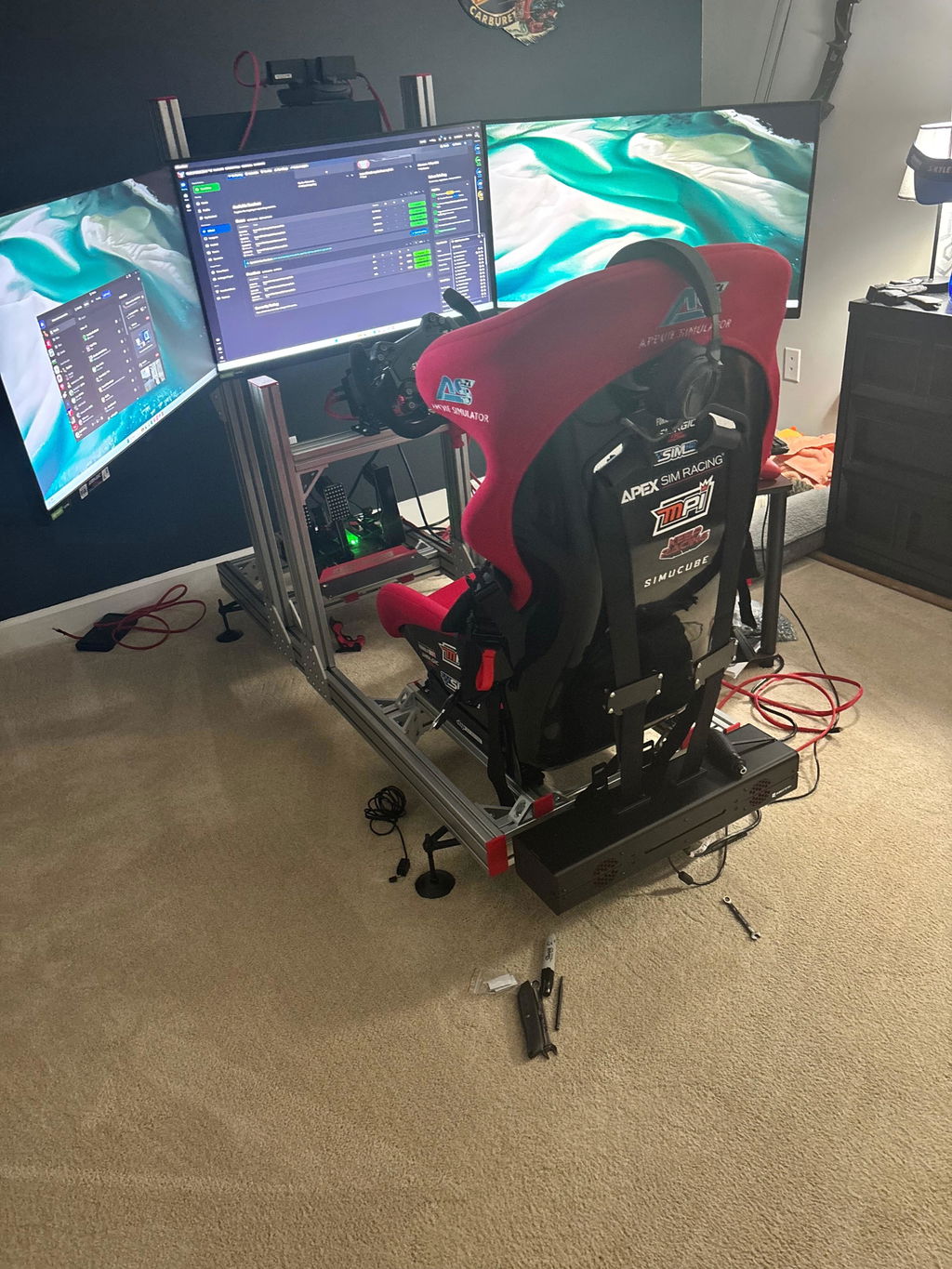
It is also important to mention that the majority of participants who heavily invest in their rig do it to someday be picked up by a F1/2/3 Team in some capacity. Having a simulator that will propel the driver to that professional level vice having a gaming system that will not have the same advantages.