The Ultimate Guide to Sim Racing Pedals: Engineering Consistency and Precision
Why do nearly 80% of professional esports drivers prioritize their footwork over their steering wheel when upgrading their cockpit? It's a question that strikes at the heart of performance because your ability to decelerate with precision is often more vital than your ability to steer. You've likely experienced the frustration of a missed apex at Monza because your entry-level hardware lacked the necessary resistance and tactile feedback. This inconsistency isn't usually a lack of skill; it's a limitation of the equipment failing to provide a realistic feel. When your sim racing pedals flex under pressure, your brain can't build the reliable habits required for elite competition.
We've designed this guide to help you master your braking zones by understanding the sophisticated engineering behind high-end hardware. You'll discover how the transition from basic travel sensors to precision load cells can help you achieve a 0.5-second improvement in lap times through pure muscle memory. We'll examine the mechanical differences between various sensor types and provide a clear framework for choosing a set that matches your specific racing style. By the end of this article, you'll know exactly how to transform your setup into a tool for surgical precision on the track.
Key Takeaways
- Understand why muscle memory, rather than visual cues, is the fundamental secret to achieving consistent braking and significantly faster lap times.
- Explore the mechanical differences between load cell, hydraulic, and active systems to identify which technology best replicates the resistance of a real race car.
- Learn why a rigid mounting solution is critical for professional-grade sim racing pedals to ensure precision and prevent energy loss during high-pressure maneuvers.
- Discover how to tailor your hardware selection to your specific racing discipline, including a modern perspective on the necessity of a dedicated clutch pedal.
- Gain insight into how elite hardware synergy and motorsport-grade telemetry create a seamless bridge between digital simulation and real-world physics.
The Science of Sim Racing Pedals: Why They Are Your Most Important Upgrade
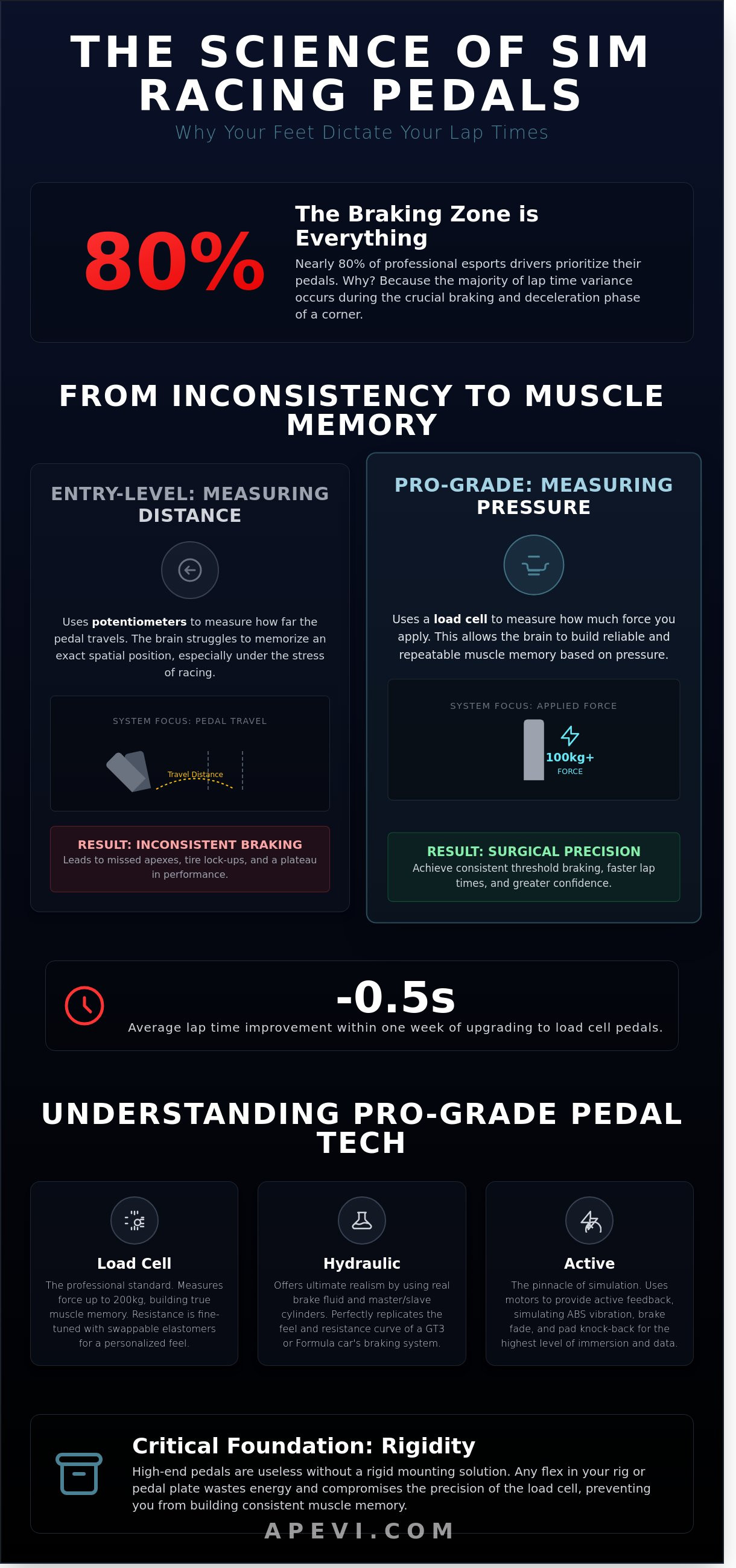
Many newcomers believe the steering wheel defines the racing experience. However, data from professional telemetry shows that 80% of lap time variance occurs during the braking phase. While a high-end wheel provides immersion, sim racing pedals dictate your consistency. High-fidelity pedals allow you to communicate with the car's limit of adhesion. This connection relies on sensory precision rather than visual guesswork. Professional systems focus on pressure, mimicking the hydraulic resistance found in real-world GT3 or Formula cars.
According to Simulator Pedal Technology, the evolution from simple electronic springs to complex load cell and hydraulic sensors has redefined how drivers interact with software. This transition is vital because the human body isn't designed to measure distance with its feet under stress. It's much easier for your leg to remember how hard to press than how far to move. This distinction is the foundation of professional-grade equipment.
Muscle Memory vs. Visual Cues
Your brain processes physical pressure much faster than it calculates the distance of leg extension. Entry-level pedals use potentiometers to measure how far the pedal travels. This requires you to memorize an exact spatial position; a task that becomes nearly impossible when your heart rate exceeds 120 beats per minute during a race. High-performance sim racing pedals utilize load cells to measure force. Your nervous system stores "pressure signatures" more effectively than "distance markers." This biological advantage makes threshold braking, the act of staying just before the point of tire lock-up, a repeatable habit rather than a lucky guess.
The "Pedal First" Philosophy
Upgrading your wheel base before your pedals is a common mistake that often leads to plateaued performance. A 2022 study of sim racing enthusiasts found that drivers switching to load cell pedals saw an average improvement of 0.5 seconds per lap within the first week. High-end pedals provide the fidelity needed to feel the subtle vibrations of the ABS or the softening of the pedal as fluid heats up. Brake feel is the tactile communication between the car’s tires and the driver’s nervous system. By prioritizing this interface, you reduce the time needed to learn new tracks. Your muscle memory adapts to the car's deceleration curve rather than specific visual braking markers, allowing for a more natural and confident driving style.
- Pressure Sensitivity: Load cells mimic real-world physics by measuring force instead of travel.
- Consistency: Muscle memory allows for identical braking force lap after lap.
- Fidelity: High-end systems transmit the "state" of the car directly to your feet.
Understanding Pedal Technology: Load Cell, Hydraulic, and Active Systems
Choosing the right hardware requires a deep dive into how these systems process your physical inputs. While entry-level gear relies on simple potentiometers that measure travel distance, professional sim racing pedals use sophisticated sensors to mimic the complex physics of a race car. The goal is to move away from measuring how far your foot moves and toward measuring how much force you apply. This shift is vital for developing the muscle memory needed to hit consistent lap times in high-pressure qualifying sessions.
Load Cell Pedals: The Professional Standard
Competitive racers prioritize load cells because they measure pressure rather than movement. This mirrors how a real braking system functions; your brain develops muscle memory based on how hard you press, not the angle of your ankle. Most high-grade units utilize sensors rated between 100kg and 200kg to ensure the hardware never bottoms out before your leg does. You can fine-tune this resistance using various elastomers. These rubber-like inserts determine the initial take-up and the final firmness of the stroke. For a deeper technical breakdown of these mechanics, The Science of Sim Racing Pedals provides extensive engineering data on force application and sensor accuracy. Since these are solid-state systems, they require almost zero maintenance, making them the most reliable choice for daily training.
Hydraulic Pedals: Replicating the Real World
Hydraulic systems, like those found in the Heusinkveld Ultimate+ or Asetek Invicta sets, use fluid-filled master and slave cylinders to create resistance. This technology offers a distinct "bite point" where the pads would theoretically meet the rotors in a physical caliper. It's the most authentic feeling available for purists who want to replicate the organic, slightly damped feel of a real hydraulic circuit. However, there are lifestyle implications to consider. Seals can eventually wear down over several years of use. While modern engineering has made leaks rare, a hydraulic set requires a level of mechanical sympathy and occasional inspection that solid-state pedals don't demand.
Active Pedals: The Future of Force Feedback
By 2026, the market is shifting toward fully motorized "Active" systems. Products like the Simucube ActivePedal eliminate traditional springs and hydraulics entirely. Instead, a powerful linear actuator controls the pedal's movement and resistance. This allows you to simulate ABS vibrations or traction control kicks directly through the sole of your shoe based on real-time telemetry. Since the feel is software-defined, you can switch from a soft 1960s road car brake to a rock-hard Formula 1 pedal in seconds without touching a wrench. This level of precision reflects the same commitment to quality found in a carefully curated wellness routine, where every detail serves a specific, performance-oriented purpose.
The Physical Requirements: Mounting, Rigidity, and Ergonomics
The most frequent oversight in high-end sim racing involves pairing professional hardware with unstable mounting surfaces. Investing in top-tier sim racing pedals without a rigid foundation is a tactical error that negates the benefits of high-fidelity sensors. When you apply 100kg of force to a heavy-duty brake, Newton’s third law dictates that an equal force travels back into your seat and the pedal plate. If your mounting solution isn't rigid, that energy dissipates into the frame rather than being captured by the sensor. This loss of energy results in a vague braking feel and inconsistent lap times. To achieve the intended performance, an aluminum profile rig is essential for maintaining a static relationship between the driver and the controls. You can explore the structural requirements further in our guide on why an aluminum profile rig is a must.
Eliminating Pedal Plate Flex
Even 1mm of movement in the pedal tray can compromise the fidelity of your inputs. Professional hardware relies on pressure rather than travel distance. Understanding Load Cell Technology is vital here; these sensors measure the exact weight applied to the pedal face. If the plate flexes, the sensor receives a delayed or dampened signal, which ruins the muscle memory required for threshold braking. Office chairs on wheels and entry-level wheel stands cannot withstand these forces. They'll simply roll backward or tilt under heavy load. For those using mid-range cockpits, adding 5mm steel reinforcement plates or additional support struts can reduce deflection, but a dedicated 80/20 profile base remains the gold standard for zero-flex performance.
Ergonomic Alignment for Performance
Correct positioning isn't just about comfort; it's a physiological necessity for long-distance racing. Improper alignment often leads to "Sim Racer’s Knee," a strain caused by repetitive force at awkward angles. High-end sim racing pedals offer modularity, allowing you to move individual pedals laterally to match your skeletal structure and driving style. Setting the correct pedal height and face angle ensures that the force comes from your hip and leg muscles rather than straining the smaller tendons in your ankle.
- GT vs. Formula Positioning: GT setups typically feature a 90-degree bend at the knee with an upright seat. Formula positions require a supine posture where the pedals sit higher than the hip line to mimic a single-seater cockpit.
- Pedal Spacing: Adjusting the horizontal gap between faces allows for specialized techniques. Left-foot brakers often prefer a wider gap to keep the hips square. Drivers using a clutch for "heel-toe" shifting need the brake and throttle close enough to blip the gas with the side of the foot while maintaining constant brake pressure.
Adjustability is the hallmark of premium equipment. By fine-tuning the stack height and inclination, you ensure that every Newton of force is applied efficiently, protecting your joints during endurance stints while maximizing your control over the car's weight transfer.
Buying Guide: Choosing the Right Pedals for Your Racing Discipline
Selecting the ideal hardware depends on your commitment to a specific motorsport category. While entry-level gear serves as a starting point, high-end sim racing pedals represent a definitive investment in muscle memory and consistency. You're not just buying metal and sensors; you're acquiring the ability to replicate a physical sensation every single time you approach a corner. This level of precision is the hallmark of "end-game" hardware that you won't need to upgrade again.
The debate between two-pedal and three-pedal configurations has reached a conclusion for many competitive drivers. By 2026, industry data shows that roughly 82 percent of professional sim racers favor a two-pedal setup. Modern racing steering wheels now feature sophisticated dual-clutch paddles, making a floor-mounted clutch redundant for GT3, Formula, or Prototype classes. If your focus remains on these modern machines, a two-pedal set provides superior ergonomics and allows for more comfortable left-foot braking positions.
Calibration software defines the bridge between your foot and the car's behavior. High-end ecosystems offer 16-bit resolution or higher, ensuring that even a 0.5 percent change in pressure is registered. This software interface matters as much as the hardware because it allows for millimetre-perfect deadzone adjustments and non-linear output curves. When you choose a system like the Simucube ActivePedal, you're investing in a platform where the software can completely transform the pedal's physical identity through telemetry-based feedback.
Formula and Prototype Racing
High-downforce cars require a brake pedal that feels like a solid wall. Drivers typically prefer ultra-stiff setups with minimal travel, often less than 25mm, to enable precise pressure modulation at high speeds. The Heusinkveld Ultimate+ or the Simucube ActivePedal are benchmarks here. These units utilize high-frequency haptics to signal ABS activation, allowing you to find the limit of grip through pure tactile feedback rather than visual cues.
GT and Touring Car Racing
GT racing demands a more progressive feel to simulate the vacuum-assisted systems found in real-world touring cars. You need a sim racing pedals set that offers a softer initial travel for trail braking finesse, followed by significant resistance for heavy stopping zones. A high-quality clutch remains essential for those who enjoy the ritual of standing starts or the technicality of manual downshifts in vintage car classes. Balancing raw stopping power with a natural, damping-rich return is key.
Just as a professional driver optimizes every aspect of their physical health for peak performance, your equipment should reflect a commitment to quality and longevity. To learn more about maintaining peak focus during long endurance stints, explore how premium natural supplements can support your cognitive clarity.
Apevie’s Curated Selection: Integrating Elite Pedal Hardware
Selecting the right hardware for a professional simulator requires more than just reading a specification sheet. At Apevie Simulators, we choose components based on motorsport-grade telemetry and physical data points. We analyze the resistance curves found in GT3 and LMP cockpits to ensure our hardware delivers an authentic experience. This scientific approach removes the guesswork that often plagues home-built setups. When we pair Simucube wheel bases with Heusinkveld pedals, we're not just connecting two devices; we're creating a synchronized ecosystem where steering torque and braking pressure feel like parts of the same machine.
Professional integration solves the hidden problems of DIY builds, such as flex in the pedal plate or signal interference. A high-end simulator must remain stable under 100kg of sudden force. We ensure every bolt and cable meets this standard. This meticulous assembly transforms a collection of parts into a reliable tool for driver development.
The Heusinkveld Standard: Sprint vs. Ultimate+
Heusinkveld has defined the Dutch standard for sim racing hardware since 2013. We offer two distinct paths depending on a driver's needs. The Heusinkveld Sprint is an exceptional choice for enthusiasts, featuring a load cell capable of handling up to 65kg of force. It provides a crisp, repeatable feel that's perfect for consistent lap times. For those seeking the highest level of immersion, the Ultimate+ model increases the brake force capacity to 140kg. This mimics the heavy, stiff pedal feel found in formula cars and top-tier endurance racers.
- Expert Calibration: Our team configures the SmartControl software to match the specific linear output requirements of platforms like iRacing and Assetto Corsa Competizione.
- Durability: These pedals use CNC precision-cut steel, ensuring they withstand thousands of hours of high-pressure use without losing their tactile edge.
- Customization: We adjust the rubber dampers and spring rates to replicate the specific "bite point" of the car you drive in the real world.
Simucube ActivePedal Integration
The Simucube ActivePedal represents a fundamental shift in how we interact with software. It replaces traditional springs and dampers with a motorized actuator that provides software-defined haptics. This technology allows a driver to feel ABS pulses, engine vibrations, and even the "thud" of a gear change directly through their foot. There's zero latency in this feedback, providing a level of sensory input that mechanical sim racing pedals simply cannot match.
Apevie provides the technical bridge between raw hardware and a race-ready simulator by translating real-world car data into ActivePedal profiles. We don't just turn the power on; we tune the software so the brake pedal gets firmer as the aero load increases, just like a real racing car. This level of detail is what separates a toy from a training tool.
Our turnkey experience is designed for drivers who value their time and performance. We handle the complex mounting, software updates, and fine-tuning. You receive a simulator that's ready for the track the moment you sit down. If you're ready to move beyond off-the-shelf compromises, explore our professional sim racing pedals and integration services today. Let's build a system that matches your ambition.
Refining Your Path to Podium Consistency
Mastering your lap times isn't just about speed; it's about the technical synergy between your physical inputs and the simulator's response. High-end sim racing pedals utilize load cell or hydraulic systems to shift your focus from pedal travel to pressure. This transition is essential for building the muscle memory required to hit the same braking point lap after lap. By eliminating the flex found in entry-level gear and focusing on professional-grade hardware, you ensure that every millisecond of deceleration is intentional. As an authorized dealer for industry leaders Simucube and Heusinkveld, Apevie provides 100% professional hardware, ensuring you never have to settle for arcade-grade equipment. Our expert technical support team offers specialized calibration guides to help you fine-tune your setup for maximum ergonomic efficiency. Choosing the right equipment is a commitment to your long-term skill development and competitive edge. Your journey toward technical excellence starts with hardware that honors the science of racing. Explore our curated collection of professional sim racing pedals and take the first step toward a more precise driving experience. You've got the talent; now it's time to give yourself the tools to prove it.
Frequently Asked Questions
Do sim racing pedals work on PS5 or Xbox?
Compatibility depends on the specific wheelbase ecosystem or the use of dedicated console-compatible adapters. Most high-end pedals connect via USB and are designed for PC, but brands like Fanatec or Thrustmaster offer 100 percent compatibility when plugged directly into their respective wheelbases. If you're using a PS5, you'll need hardware that's officially licensed for that platform to ensure the electronics communicate correctly.
What is a load cell and why is it better than a standard pedal?
A load cell is a transducer that measures the physical pressure you apply rather than the distance the pedal moves. Standard potentiometers only track the 0 to 100 percent travel distance, which is less intuitive for the human brain. Because your body remembers pressure better than position, 90 percent of competitive drivers find that load cells allow for more consistent muscle memory and better trail braking.
How much force should I set my sim racing brake to?
You should set your brake force based on your physical comfort and the structural limits of your racing rig. Professional drivers often configure their load cells between 40kg and 60kg for GT3 simulations to mimic real-world resistance. If you're using a desk setup, a lower setting of 20kg is safer. This prevents your chair from sliding back and ensures you can reach full braking potential without physical strain.
Do I need special shoes for high-end sim racing pedals?
Specialized footwear is highly recommended for high-end sim racing pedals to protect your feet from the high pressure required by professional systems. Barefoot driving often becomes painful when applying over 30kg of force during long sessions. Karting shoes or thin-soled racing boots provide a 3mm protective layer and the necessary grip. This allows for precise modulation without the discomfort associated with stiff metal faceplates.
Can I mount professional pedals to a desk or wheel stand?
Professional sim racing pedals require a dedicated cockpit or a heavily reinforced stand to handle extreme pressure. A load cell set to 80kg can easily tip a standard 15kg office chair or cause a 2cm thick wooden desk to flex significantly. For a stable and reliable experience, you'll need an 8020 aluminum profile rig. These structures provide the zero-flex environment necessary for high-performance hardware to function as intended.
Is it worth buying a clutch pedal if I only use paddle shifters?
A clutch pedal isn't necessary for modern GT3 or Formula cars but remains essential for historic racing and manual immersion. Approximately 85 percent of modern competitive racers prefer dual-clutch paddles on the steering wheel for standing starts. However, if you enjoy drifting or rally simulations, a physical clutch is vital. It provides the 100 percent authentic control needed for advanced techniques like clutch kicking or rev-matching.
How do I calibrate my pedals for iRacing or Assetto Corsa Competizione?
Calibration involves using the in-game setup wizard or the manufacturer's proprietary software to define your input limits. In iRacing, you must depress the pedal through its full range to set the 0 and 100 percent points accurately. It's a good idea to set a 3 percent deadzone at the start of the travel. This prevents "ghost" inputs if you accidentally rest your foot on the pedal plate during a long straight.
What is the difference between hydraulic and load cell sim pedals?
Hydraulic pedals use fluid pressure and a master cylinder to create resistance, while load cells rely on electronic strain gauges. The hydraulic system offers a 1:1 feel compared to a real car's braking system, providing natural dampening that electronics can't perfectly mimic. While load cells are more common and require less maintenance, hydraulic sets are often preferred by professional drivers who want the most authentic mechanical feedback available.