Choosing pedals for a sim racing setup
A three-pedal set isn’t automatically the right choice: Fanatec pedals are available in configurations suited to different driving styles, from a two-pedal throttle-and-brake setup to sets that add a clutch. The ClubSport Pedals V3 use an adjustable 90 kg load cell in the brake, while CSL and Podium options give you other configurations to consider. Your choice should reflect how you race, how you brake, and what your wheel base and platform support.
It’s easy to focus on pedal count or headline features, but brake feel and how the pedals fit your rig can matter more than choosing the most elaborate set. If you’re weighing an upgrade or building your first serious setup, start by asking which features you’ll actually use.
This guide compares Fanatec pedals and explains what to consider, including two- versus three-pedal layouts, load-cell braking, compatibility and mounting. You’ll have a clearer basis for choosing pedals that suit your racing discipline and the rest of your equipment.
Key Takeaways
- Match your pedal layout to your racing style: a throttle-and-brake set can suit formula driving, while a clutch is useful for disciplines that call for it.
- Compare brake technology, not just pedal count: the ClubSport Pedals V3 use a load-cell brake, while CSL Pedals and CSL Elite Pedals V2 use Hall-effect sensors.
- Plan for your platform and connection method, since console use depends on a compatible Fanatec wheel base, while PC setups offer USB connection options.
- Consider mounting and pedal position as part of the decision; a firm, adjustable setup helps you use consistent braking inputs.
- If you’re building beyond the pedals, Apevie Simulators can bring them into a custom high-performance simulator with options such as Heusinkveld Sim Pedals Sprint and Sigma Integrale motion systems.
Fanatec pedals
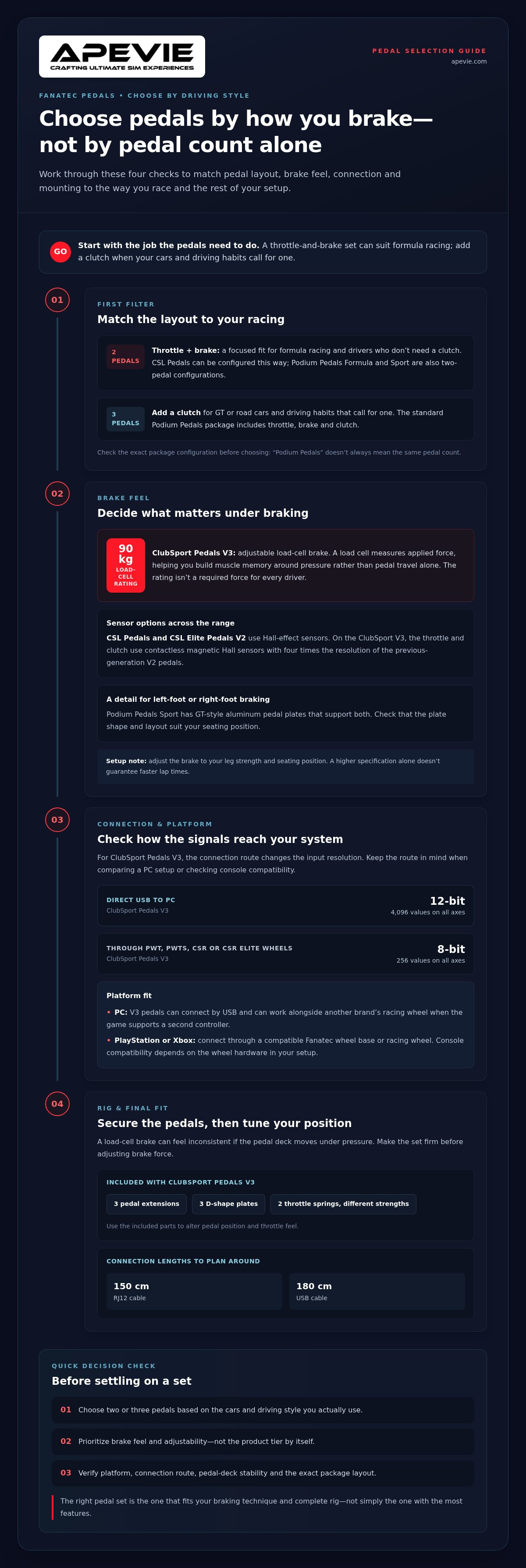
Choose a Fanatec pedal set by matching its brake, layout, and connection to your racing style. For example, a formula driver may prefer two pedals, while a driver who uses a clutch needs a three-pedal arrangement. Fanatec’s range includes CSL Pedals, CSL Elite Pedals V2, ClubSport Pedals V3, and Podium Pedals. Their differences matter most in braking feel, adjustability, and how they connect to your system.
Start with the brake. A load-cell brake measures applied force, so you can build muscle memory around pressure rather than pedal travel alone. The ClubSport Pedals V3 have an adjustable 90 kg load cell. That figure describes the brake’s load-cell rating, not a required force for every driver. Adjusting the brake to suit your leg strength and seating position is more useful than choosing a setting simply because it sounds demanding.
Compare brake feel and pedal layout
The ClubSport Pedals V3 use a full CNC-machined aluminum construction, with contactless magnetic Hall sensors on the throttle and clutch. Those sensors have four times the resolution of the previous-generation V2 pedals. The set also provides 12-bit resolution, or 4,096 values, on all axes when connected directly to a PC by USB. That gives the game more input steps to read, though consistent braking still depends on setup and technique.
CSL Pedals and CSL Elite Pedals V2 use Hall-effect sensors. CSL Pedals can be configured with two pedals for formula racing, making them a direct fit for drivers who don’t need a clutch. The standard Podium Pedals package includes throttle, brake, and clutch. Podium Pedals Formula and Podium Pedals Sport are two-pedal configurations, so check the exact layout before choosing a set.
Use your racing discipline as the first filter, then compare brake design and adjustability:
- Formula racing: A two-pedal layout can keep the setup focused on throttle and brake.
- GT or road cars: Choose a clutch if your cars and driving habits call for one.
- Load-cell braking: Consider the ClubSport Pedals V3 if brake-force adjustment is a priority.
- Podium configuration: Distinguish the three-pedal standard package from the two-pedal Formula and Sport sets.
Check connection and platform compatibility
Connection method affects compatibility and input resolution. On PC, the ClubSport Pedals V3 can connect by USB, and they can work alongside another brand’s racing wheel when the game supports a second controller. Through PWT, PWTS, CSR, or CSR Elite wheels, the V3 pedals operate at 8-bit resolution, or 256 values, on all axes. That differs from the 12-bit USB connection, so the route into your PC is part of the buying decision.
On PlayStation or Xbox, connect the V3 pedals through a compatible Fanatec wheel base or racing wheel. Console connection options depend on the hardware in your setup. The V3 are listed as ready for PC, PS4, and Xbox One, while console compatibility still depends on the wheel hardware in your setup. Verify that the complete combination matches your platform before selecting pedals.
Finally, consider mounting and tuning. A load-cell brake can feel inconsistent if the pedal deck moves under pressure, so secure the set before adjusting brake force. The V3 package includes three pedal extensions, three D-shape plates, and two throttle springs with different strengths. Those parts let you alter pedal position and throttle feel. A 150 cm RJ12 cable and 180 cm USB cable also give you defined connection options to plan around your rig.
Their gas and clutch use contactless magnetic Hall sensors with 4x the resolution of the previous-generation V2 pedals, complementing the brake-focused adjustability described above. Consider whether those details matter to your priorities, rather than treating a higher specification or price as a guarantee of faster lap times.
Fanatec Podium Pedals Sport has GT-style aluminum pedal plates that support both left-foot and right-foot braking. This flexibility may suit drivers who want the option to brake with either foot, but the pedal plate shape and layout should still match your seating position. Compare the configuration with your driving style and the rest of your setup, and choose based on how you brake rather than the product tier alone.
Apevie Simulators: Custom High-Performance racing simulator
Apevie Simulators can help when choosing pedals is part of a wider simulator build, rather than a standalone upgrade. Its custom high-performance racing simulators bring the full setup into focus, so you can consider pedal choice alongside your driving goals and the rest of the system.
If you’re comparing a Fanatec set with another pedal option, Apevie also offers Heusinkveld Sim Pedals Sprint. That gives you a concrete alternative to consider within a complete build. For drivers interested in motion, the Sigma Integrale DK2 and DK2+ Motion Systems are additional components to discuss as part of the simulator configuration.
Contact Apevie Simulators to discuss a custom racing simulator and get guidance on your setup.
Build a setup around how you drive
Once you’ve chosen your pedals, the next decision is how to bring the complete simulator together. Apevie Simulators offers turnkey racing simulator packages and white-glove installation, helping you plan and put your finished setup in place.
This can be useful if you’re moving from separate hardware purchases to a complete build or want professional guidance as you plan the system. Discuss your goals with Apevie Simulators and consider the wider simulator configuration as a whole, rather than treating each component as an isolated choice.
Ready to explore your options? View Fanatec pedal options, then contact Apevie Simulators to discuss a turnkey build or professional consultation. A thoughtful setup gives you a clear foundation to keep refining your driving.