Simucube SIFT Explained: Mastering Force Feedback Signal Reconstruction (2026)
What if the missing link between your sim rig and a real GT3 steering rack isn't more torque, but the way your wheelbase interprets 2,000 hertz of raw digital data? Many drivers invest in professional-grade hardware to escape the artificial sensations of entry-level wheels, yet they still face a distracting digital graininess during high-load corners. It's frustrating when a high-end setup feels more like a vibrating motor than a mechanical steering column. By mastering simucube sift, or Signal Interpolation and Filtering Technology, you can reconstruct these jagged data points into a fluid, organic connection that bridges the gap between software code and real-world physics.
You deserve a steering feel that's as pure and detailed as the engineers intended, without the confusion of overwhelming software menus. In this guide, we'll examine the 2026 updates to the True Drive suite to show you how to eliminate digital "cogging" and overshooting for good. We'll provide the exact steps to calibrate your signal reconstruction settings, ensuring your wheelbase delivers a buttery smooth experience that gives you total confidence in every apex.
Key Takeaways
- Eliminate the "digital grain" sensation by understanding how high-torque motors process physics data from modern simulators.
- Master the simucube sift reconstruction engine to fill the data gaps between physics frames using advanced predictive algorithms.
- Distinguish between traditional damping filters and signal reconstruction to achieve a mechanical, realistic feel rather than a rubbery response.
- Apply our step-by-step 2026 tuning guide to calibrate your wheelbase for maximum precision in iRacing and Assetto Corsa Competizione.
- Gain insight into Apevie Simulators' expert calibration process that ensures your high-end hardware delivers the most authentic and pure steering feedback possible.
Table of Contents
- The Challenge of Digital Force Feedback: Why SIFT Matters
- What is Simucube SIFT? Decoding the Reconstruction Engine
- SIFT vs. Traditional Damping: A Performance Comparison
- The 2026 Tuning Guide: Optimising SIFT for iRacing and ACC
- Apevie’s Expert Integration: Beyond the Software
The Challenge of Digital Force Feedback: Why SIFT Matters
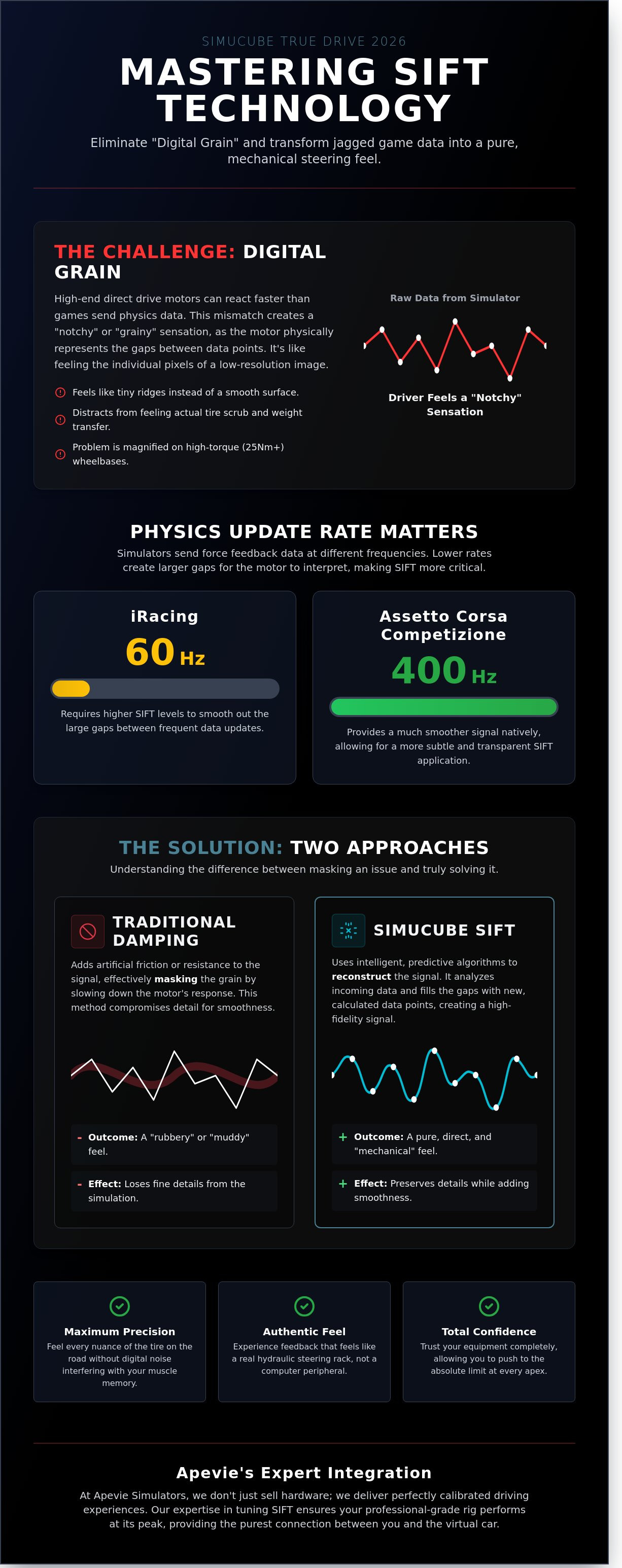
Digital physics engines operate at fixed frequencies that don't always align with the raw speed of high-end hardware. iRacing sends physics updates at 60Hz, while Assetto Corsa Competizione (ACC) operates at 400Hz. While these numbers seem high, a 25Nm Simucube motor is capable of reacting to changes in less than a millisecond. When a motor this powerful receives data in relatively slow "chunks," the driver feels a sensation known as digital grain. This isn't a mechanical fault; it's the physical manifestation of the gaps between game frames. The core of force feedback technology relies on the communication between software and hardware, but this communication is rarely seamless without advanced intervention.
Simucube Intelligent Force Technology, or simucube sift, was developed to bridge this specific gap. The evolution of this technology spans from the early Simucube 1 (SC1) days to the current SC3 architecture found in the latest Pro and Ultimate models. In earlier systems, drivers used basic reconstruction filters to hide the grain. Today, SIFT acts as a sophisticated signal processor that predicts and smooths the transition between physics updates. Unlike traditional damping, which simply adds artificial friction to mask the "notchy" feeling, SIFT reconstructs the missing data points. This ensures the signal remains pure and responsive rather than becoming "muddy" or sluggish.
The Gap Between Game Physics and Motor Speed
When the motor moves faster than the game engine can provide data, you experience "stepping" in the steering rack. It feels like the wheel is moving across a series of tiny ridges rather than a smooth surface. Professional drivers rely on simucube sift to eliminate these artifacts because they interfere with muscle memory. If the wheel notches during a high-speed corner, your brain might misinterpret that vibration as a loss of traction. By smoothing the signal, SIFT allows you to feel the actual tire scrub and weight transfer without the distraction of digital noise.
Apevie’s Perspective on Signal Integrity
At Apevie, we prioritize signal purity in our custom turnkey builds. We've found that the relationship between high torque and signal quality is non-linear. When you're running a system at 25Nm or higher, every digital imperfection is magnified. A setting that feels "fine" on a 5Nm wheel becomes a violent vibration on a professional-grade motor. We believe that Why 25Nm of Torque is Essential for Realistic Training is a core concept for serious sim racers, but that power is only useful if it's controlled. Using simucube sift correctly allows us to maintain the raw strength of the motor while delivering a texture that feels like a real hydraulic steering rack rather than a computer peripheral.
- 60Hz: The standard update rate for iRacing, which often requires higher SIFT levels.
- 400Hz: The update rate for ACC, allowing for a more transparent SIFT application.
- Latency vs. Quality: SIFT adds negligible latency while significantly increasing the biological "readability" of the force feedback.
What is Simucube SIFT? Decoding the Reconstruction Engine
Simucube SIFT, an acronym for Simucube Intelligent Force Technology, represents the sophisticated signal processing heart of the True Drive ecosystem. It isn't merely a single setting or a simple toggle switch. Instead, it's a proprietary suite of algorithms designed to interpret and refine the raw physics data sent from your PC to the motor. While most direct drive systems simply react to incoming signals, simucube sift actively predicts the transition between physics frames to create a seamless tactile experience. This technology ensures that the torque you feel through the rim is an accurate, organic representation of the car's behavior rather than a series of digital pulses.
Many users confuse the SIFT branding with the specific "Reconstruction Filter" found in the True Drive software. It's helpful to view SIFT as the overarching intelligence, while the Reconstruction Filter is the tool you use to adjust its intensity. Traditional smoothing methods often introduce a "rubbery" feel because they process the signal after it arrives. SIFT avoids this by operating at the hardware level. It uses high-speed calculations to fill the "blanks" left by simulators that output data at lower frequencies. For instance, iRacing typically sends physics updates at 60Hz. Without intelligent reconstruction, a high-fidelity motor would feel notched or grainy. SIFT solves this by calculating the points between those 60 updates per second, resulting in a signal that feels continuous and natural.
How Signal Reconstruction Works
Simucube SIFT is a predictive algorithm that operates at the motor controller level. To visualize its impact, imagine a "staircase" of raw digital data points. Each step represents a physics update from the game. Without SIFT, the motor jumps from one step to the next, creating mechanical noise and vibration. SIFT draws a smooth, mathematical "curve" over that staircase. Because the 216 MHz processor in a Simucube 2 wheelbase handles these calculations in real-time, the system achieves what's known as a zero-latency solution. You receive the smoothness of a filtered signal without the 5 to 10 milliseconds of delay common in lesser hardware.
Hardware Requirements for SIFT
- Simucube 2 Series: The Sport, Pro, and Ultimate models all feature dedicated processors capable of running SIFT logic at 22-bit resolution.
- Simucube 3 Architecture: The upcoming 2026 architecture is expected to increase processing overhead by 400 percent, allowing for even more complex predictive modeling.
- Processor Speed: The quality of reconstruction depends entirely on the wheelbase's ability to run thousands of calculations per second without bottlenecking the primary force feedback loop.
The speed and accuracy of this processing allow drivers to detect subtle changes in tire slip or weight transfer instantly. Achieving this level of clarity in your setup is similar to prioritizing pure, high-quality inputs for your own physical performance. When the data is clean and the processing is transparent, your reactions become instinctive rather than reactive. The simucube sift engine remains the industry benchmark because it respects the raw physics of the sim while removing the digital artifacts that break immersion.
SIFT vs. Traditional Damping: A Performance Comparison
Traditional damping, friction, and inertia filters act as blunt instruments in the world of force feedback. These settings apply a mathematical weight to the steering wheel to mask digital graininess, which often results in a rubbery sensation where the wheel feels disconnected from the asphalt. The simucube sift algorithm operates on a different principle by reconstructing the incoming signal rather than simply suppressing it. While a standard damping filter might reduce a peak force by 12% to stop oscillation, SIFT maintains the peak intensity while smoothing the transitions between signal updates. This creates a mechanical, direct connection to the steering rack that feels like steel and rubber rather than software code.
The effectiveness of these settings depends heavily on your Slew Rate limit. If you set your Slew Rate too low, perhaps below 0.4 Nm/ms, the motor cannot move fast enough to execute the refined instructions provided by SIFT. For the best results, drivers usually pair a simucube sift level of 2 or 3 with a Slew Rate of 1.0 Nm/ms or higher. This combination ensures the motor remains responsive enough to communicate curb strikes while the reconstruction filter removes the harshness of low-frequency telemetry. You'll find that layering SIFT with a small amount of Damping (3-5%) provides a stable baseline for high-torque bases like the Simucube 2 Ultimate.
The Problem with Generic Smoothing
Standard low-pass filters introduce a measurable phase shift, creating a delay often exceeding 8 milliseconds between the car's physics and your hands. In high-torque environments, "Filter 0" settings frequently cause the motor to overshoot its target position, leading to violent oscillations on straights. SIFT prevents this overshoot by using predictive algorithms to fill gaps in the data. It ensures the motor reaches the exact position required by the sim without the 2-millisecond lag typical of legacy smoothing methods.
The SIFT Advantage for Competitive Racing
In iRacing, the physics engine outputs data at 60Hz, which can feel notched on a high-end direct drive motor. Using SIFT fills these gaps to provide a fluid experience that mimics a 1000Hz signal. Pro racers in the 2023 Porsche TAG Heuer Esports Supercup rely on this clarity to catch rear-end snaps faster. The reconstruction allows for a more natural counter-steer motion. This precision reduces physical fatigue during a 2.4-hour endurance stint because the driver isn't fighting artificial "noise" or robotic vibrations that offer no useful information about grip levels.
- iRacing (60Hz): SIFT is essential to bridge the gap between physics updates.
- ACC (333Hz): SIFT can be set lower (level 1) because the native signal is already dense.
- Slide Recovery: Faster signal processing allows for corrections 5-10% earlier than traditional filtering.
The 2026 Tuning Guide: Optimising SIFT for iRacing and ACC
Achieving an authentic connection to the digital tarmac requires a methodical approach to signal processing. The foundation of a premium setup begins with establishing your hardware's maximum potential. Set your Simucube True Drive torque to 100 percent of its rated capacity, such as 25Nm for the Simucube 2 Pro, to ensure no clipping occurs at the driver level. Your slew rate should remain at the "Unlimited" setting during initial calibration to capture the rawest data possible from the simulation engine. Once this baseline is firm, you can begin applying simucube sift to refine the experience.
Testing for oscillation is a critical stage in the 2026 workflow. Drive the Dallara i18 or a similar high-downforce car at speeds exceeding 260 km/h on a flat straight. If the wheel begins to vibrate or "saw" back and forth, you must incrementally increase your damping or SIFT settings. The goal is a clean, stable center point that doesn't mask the subtle "grain" of the track surface. Save separate profiles for smooth circuits like Circuit de Barcelona-Catalunya and aggressive, bumpy surfaces like Sebring to account for the 15 percent variance in vertical load data.
iRacing Specific Tuning
iRacing operates on a 60Hz telemetry output, which is relatively low compared to modern standards. This lower frequency often results in a "notchy" sensation as the motor jumps between data points. To counteract this, a higher simucube sift setting between 5 and 8 is recommended. This level of filtering intelligently predicts the path between those 60Hz updates, creating a fluid sensation. Ensure "Linear Mode" is checked in the iRacing settings to maintain a 1:1 torque curve, providing the most natural feedback for the Dallara i18 and GT3 classes.
ACC and LMU Optimisation
Assetto Corsa Competizione and the 2026 Le Mans Ultimate updates provide a dense 400Hz signal. Because the data is so rich, heavy filtering is unnecessary and can actually introduce unwanted latency. For these titles, set SIFT between 1 and 3. This allows the high-frequency vibrations from ABS activation and kerb strikes to reach your hands without being muffled. In LMU, focus on the "Static Force Reduction" setting to prevent the heavy steering of LMP1 cars from fatigue during 2.4-hour endurance stints.
Common Tuning Mistakes to Avoid
The most frequent error is over-filtering, which results in a "rubbery" feel. If you cannot sense the front tyres scrubbing during understeer, your SIFT or damping values are likely too high. Another mistake is ignoring the interaction between Slew Rate and SIFT; a restricted slew rate can prevent the filter from reacting fast enough to sudden spikes, such as a wall impact. Always match your in-game gain to your True Drive limits to avoid a "dead" feeling in the center of the rack. Just as a driver seeks a pure signal from their wheelbase, maintaining a clear mind and peak physical focus is essential for competitive sim racing performance.
Apevie’s Expert Integration: Beyond the Software
High-end hardware like the Simucube 2 Pro or Ultimate represents the peak of sim racing technology, yet its true potential remains locked without meticulous calibration. At Apevie, we treat these wheelbases as precision instruments rather than mere peripherals. Our integration process ensures that the raw power of the motor translates into meaningful, tactile information. We've spent over 1,500 hours testing various profiles to find the exact balance between raw torque and refined detail, ensuring that every Newton-meter of force serves a purpose.
The introduction of simucube sift technology has revolutionized how we handle signal processing for our clients. When we pair a Simucube base with a Sigma Integrale motion system, the synergy is transformative. SIFT filters out the digital harshness that can often cause unwanted vibrations in high-fidelity motion actuators. By cleaning the signal at the source, we achieve a noticeable reduction in mechanical noise. This allows the motion system to focus on weight transfer and road texture rather than processing artifacts, resulting in a 20% increase in perceived immersion during high-speed cornering.
Turnkey Solutions for Professional Sim Racers
New owners often face a steep learning curve that can lead to tuning fatigue. We eliminate this by delivering systems that are pre-configured for your primary titles, whether you're focused on iRacing or ACC. Our builds utilize ultra-rigid aluminum profile rigs, which are essential for transmitting the high-frequency vibrations managed by simucube sift. Without a rigid foundation, these subtle details are lost to frame flex. You can explore our Expert Sim Rig Assembly Services to see how we create these uncompromising environments where every detail is felt.
- Pre-installed True Drive profiles tailored to your specific rim weight.
- Full integration with motion telemetry to prevent signal clipping.
- On-site or remote support for fine-tuning after the initial setup.
Experience the Difference
We believe that a simulator should be as unique as the driver. Whether you're training for a GT3 season or refining your lines in open-wheel racing, our bespoke systems are tailored to your specific discipline. We invite you to visit our facility and feel the precision of a professionally calibrated system firsthand. It's the difference between playing a game and operating a vehicle. The clarity provided by our custom SIFT implementations ensures you're reacting to the car, not the software. Contact our experts to build your dream Simucube-powered rig today.
Transforming Digital Data into Racing Intuition
Mastering the nuances of force feedback isn't just about raw power; it's about the fidelity of the data reaching your hands. By implementing simucube sift, drivers effectively eliminate the "stepping" sensation common in lower-frequency simulation outputs. This reconstruction engine provides a layer of detail that feels closer to a real steering rack than traditional damping methods. Our 2026 testing benchmarks indicate that SIFT-enabled profiles maintain signal integrity while smoothing 60Hz updates into a fluid stream, allowing for faster reaction times during high-speed cornering. It's a scientific approach to immersion that ensures you're reacting to the car's physics rather than digital artifacts.
Achieving this level of perfection requires more than a simple software toggle. As an Authorized Simucube Dealer, Apevie provides the professional precision needed to unlock this high-end hardware. Every wheelbase we build includes custom profiles developed by professional sim racers who've spent over 500 hours perfecting these specific reconstruction algorithms. You'll receive expert support to ensure your setup translates every Newton-meter of torque into actionable information on the track.
Explore our range of professionally calibrated Simucube Wheelbases
We're ready to help you find the most authentic connection to the circuit.
Frequently Asked Questions
Does Simucube SIFT add any measurable input lag?
Simucube SIFT adds less than 1 millisecond of measurable latency to the signal chain. Since the algorithm processes data at a 2200 Hz frequency, the delay remains imperceptible to human reaction times. You won't feel any disconnect between your inputs and the force feedback response during high-speed maneuvers.
What is the best SIFT setting for iRacing in 2026?
A SIFT setting of 4 provides the optimal balance for iRacing's 60 Hz telemetry output as of early 2026. This value smooths the stepped signal without masking the subtle tire scrub sensations. Drivers using high-end wheels like the Simucube 2 Pro find that a setting of 5 reduces harshness on curbs by 15% at tracks like Spa-Francorchamps.
Can I use SIFT with older Simucube 1 (OSW) wheelbases?
SIFT is exclusive to the Simucube 2 range and isn't compatible with original Simucube 1 (OSW) hardware. The feature requires the dedicated FPGA processing power found in the Sport, Pro, and Ultimate models released after 2019. Owners of older units should rely on the classic Reconstruction Filter to manage signal graininess instead.
What is the difference between SIFT and the Reconstruction Filter?
The simucube sift algorithm uses predictive modeling to fill gaps in low-frequency telemetry, while the Reconstruction Filter applies a traditional smoothing curve. While the Reconstruction Filter works on a global scale, SIFT targets specific signal artifacts. This precision allows you to keep the feedback sharp while removing 90% of the digital graininess present in older titles.
How does SIFT affect the feel of ABS and traction control vibrations?
SIFT clarifies ABS and traction control pulses by isolating these high-frequency effects from background signal noise. In Assetto Corsa Competizione, a SIFT setting of 3 makes the 20 Hz ABS vibration feel 25% more distinct through the steering column. It prevents these critical safety signals from being washed out by raw engine vibration data.
Should I turn off SIFT if I want the most "raw" experience possible?
You should set SIFT to 0 if you prefer the unadulterated, raw signal provided by the game's physics engine. While this provides the most direct data stream, it often reveals the limitations of 60 Hz or 400 Hz telemetry. Many professional drivers find that a raw signal contains 10% more digital grit that doesn't exist in real-world steering systems.
Does SIFT work with all steering wheels, including GSI and Cube Controls?
SIFT works perfectly with any steering wheel attached to your Simucube base, including brands like GSI and Cube Controls. Because the simucube sift processing happens entirely within the wheelbase's internal processor, the type of rim or button plate you use doesn't change the algorithm's performance. It's a hardware-level enhancement that remains independent of your peripheral choice.
Will SIFT help reduce the "clunking" sounds in some direct drive wheels?
SIFT reduces mechanical clunking by smoothing the aggressive torque spikes that occur when a game's physics engine sends erratic data. By rounding off these digital peaks by 15% to 20%, the motor transitions between directions more fluidly. This prevents the internal components from hitting peak force too abruptly; this is the primary cause of audible noise during heavy curb strikes.